Volume 10 of 10 · For City People
Community
The Final Boss Is Talking to Your Neighbors
How do you organise neighbours before an emergency?
Gathering first, paper second — never the reverse. Start with a potluck and circulate the skills sheet at minute 40, not minute 0. Then build a texting tree: two coordinators, each person contacting two or three households chosen by proximity rather than friendship. That reaches 40 homes in three steps with nobody sending more than three messages.
From Community for City People by Dr. Buck Savage†. 198 pages · 13 illustrations.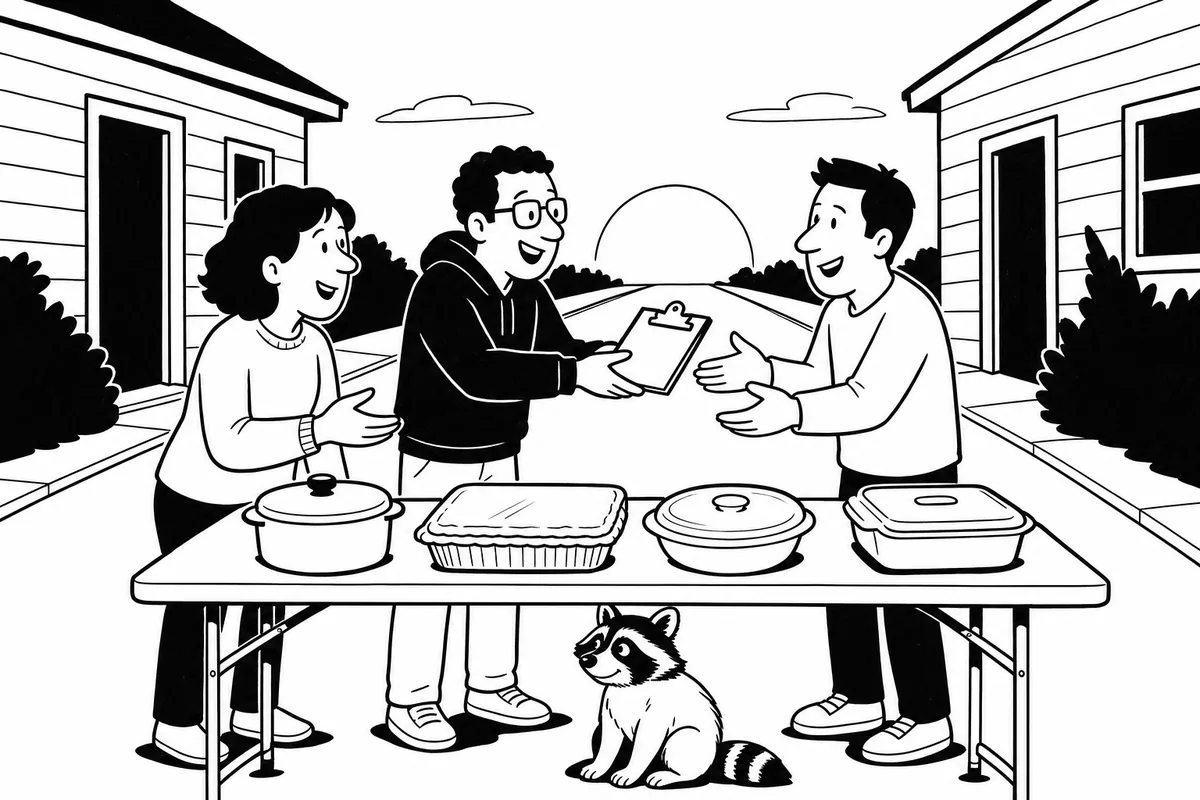
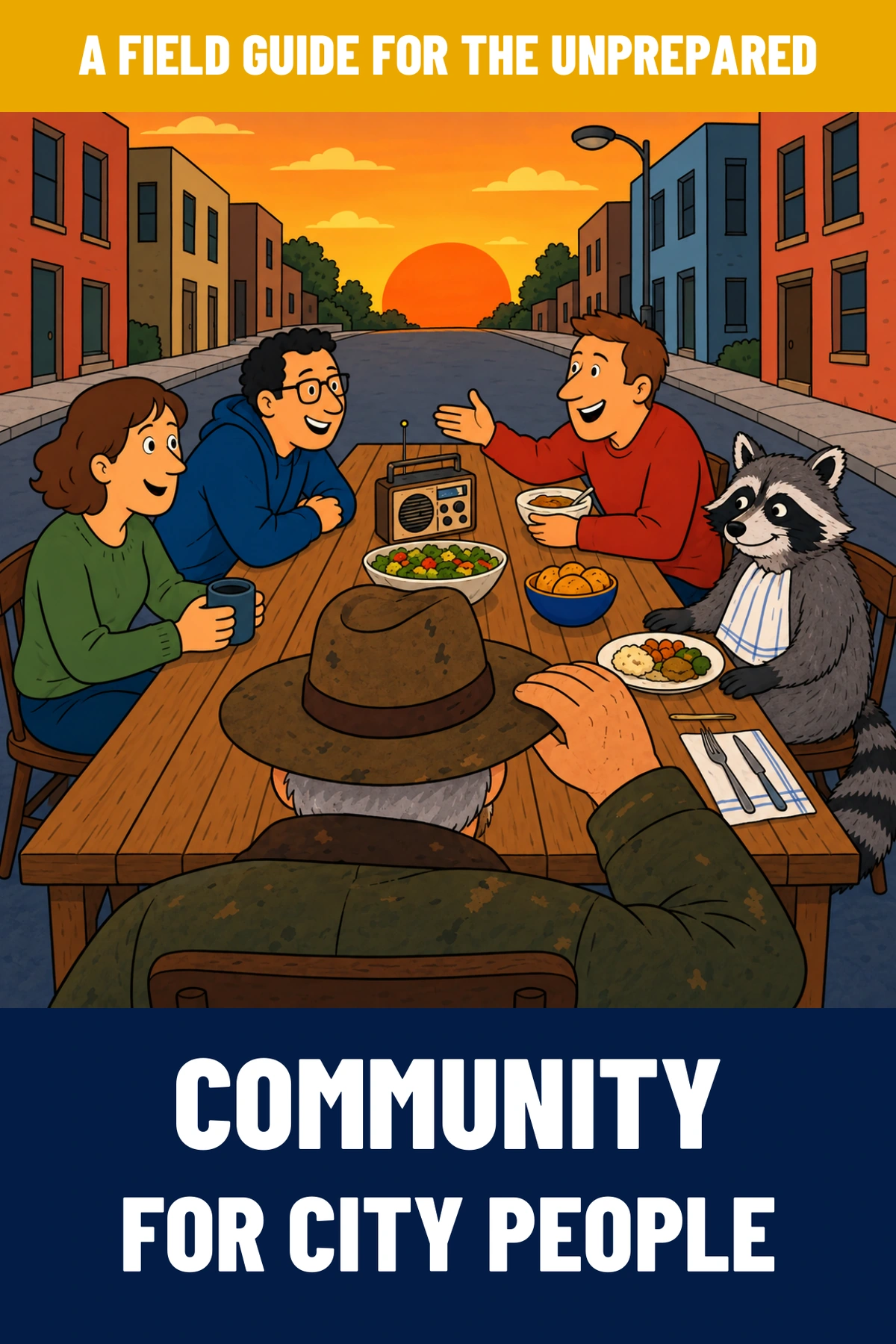
Nine books of water, fire, food, wounds and locks — and the thing that actually keeps you alive lives forty feet away and you have never learned its name.
Buying it for somebody else? Find their field guide.
4 things this book knows
Quoted from Community for City People exactly as printed. Every figure is the book’s own.
- Outdoors means at least 20 feet from the building, with the exhaust pointed away from every door, window, and vent — yours and your neighbor’s.
- The numbers, cold and exact, because food safety after outages is chemistry, not vibes: An unopened full freezer holds safe temperatures about 48 hours.
- A refrigerator holds safe temperature about 4 hours unopened.
- Dry ice, if your area has a post-storm supplier: about 50 pounds holds an 18-cubic-foot freezer roughly 2 more days.
The reference cards, free
Straight out of this volume’s own appendix, which opens by telling the reader to photocopy it freely and laminate it shamelessly.
CARD 1 — THE SKILL-MAP TEMPLATE (the census of quiet competence)
Order of operations: gathering first, paper second. Never reverse.
The census card (one per household, index card or one row of a table):
Household: Unit/address: (keepers’ copy only) Names: Best contact: SKILLS offered: (medical — specify type; electrical; plumbing; carpentry; mechanical/small engine; radio/comms; languages spoken; childcare; eldercare; cooking in quantity; sewing; chainsaw; forms/paperwork; teaching; other) TOOLS/RESOURCES will lend: (generator; chainsaw; ladder >20 ft; pump; shop vac; truck/van; chest freezer space; large grill/smoker; jump pack; dolly; yard/space) NEEDS (volunteered only): (record as actions: “check first in outage — powered medical device”; “no stairs”; “lives alone — heat list”; “language: “) Heat/cold check list? Y / N Texting tree? Y / N Consent date + initials:
The rules (from Chapter 2 — they are the system): 1. Opt-in only. Every entry consented, dated. Remove on request, immediately, no questions. 2. Two named keepers hold the full set. Everyone knows who they are. Paper or one access-controlled note — never an open shared doc. 3. Nothing public ever pairs capabilities or needs with addresses/units. 4. Needs recorded as actions, not diagnoses. 5. Pencil. Re-verify every entry twice a year (when the clocks change). 6. Working scale: ~10 households covers most core skills. Bigger block = two overlapping maps.
CARD 2 — THE TEXTING-TREE TEMPLATE
Structure: 2 coordinators (the trunk) → each person contacts 2–3 assigned households → each of those contacts 2–3 more. Assign by proximity, not friendship — your branch is the doors you can physically knock.
The math: 1 → 3 → 9 → 27 = 40 households in 3 steps, nobody sends more than 3 messages.
Fill in (wallet card — one per household, plus one on the fridge):
MY TREE CARD I am contacted by: (☎ ) I contact: 1) (☎ ) 2) (☎ ) 3) (☎ ) Coordinators: / Out-of-area check-in contact: No answer by text → knock. No answer by knock → tell your branch upward.
Message discipline: facts + source, or “UNCONFIRMED,” or don’t send. Completion and failures report UP the branch (“my 3 confirmed” / “no answer at “). The no-answers become the knock list.
Channels (Chapter 4): URGENT (safety only, ruthlessly clean) / LOGISTICS / SOCIAL. The social channel keeps the system alive between emergencies; the URGENT channel stays sacred or it dies.
⬛ 911 first, always, before any tree message. During congestion: text, don’t call; keep necessary calls under one minute.
Drill twice a year, unannounced: full propagation with up-chain accounting. Target: under 30 minutes. The harvest is the dead numbers — fix them same week.
CARD 3 — POTLUCK-AS-INFRASTRUCTURE STARTER KIT
The design (Chapter 3): monthly cadence, fixed logic (“first Sunday”); rotating host; 8–12 core households; one list, no minutes; no treasury, no titles, no bylaws. Anchor in existing space: library room, worship basement, garden, lobby, driveway.
Launch sequence: 1. Pick a date 3–4 weeks out. Flyer under every door + lobby/corkboard: “Block potluck. [Date, time, place.] Bring a dish or just come. No agenda, decent chicken.” 2. At minute 40 — not minute 0 — circulate the sheet: “Who knows how to do stuff? Building a list of who to call before we call 311.” 3. Before people leave: next date, next host. That’s the entire business meeting. 4. Census cards (Card 1) filled at potluck #2 or #3, once it’s normal.
Recruiting script (3 sentences, total): “We do a potluck, first Sunday. No agenda, decent chicken. Come or don’t.” The or-don’t is the active ingredient.
⬛ Food-safety card (posted at every event): - Danger zone 40°F–140°F. Hot dishes stay >140°F (crockpot/chafing); cold stay <40°F (ice bath). - Discard perishables out 2+ hours (1 hour if >90°F outside). Reheat leftovers to 165°F. - Label allergens: nuts, dairy, eggs, gluten, shellfish, soy. Cook answers questions or the dish sits out. - Accessible venue; sober host if alcohol; venue rules checked.
Failure modes to design against: the Clipboard Person (give a bounded real job), treasury (pass a hat per-need instead), bylaws (refuse), founder dependence (test: does it meet when the founder’s away?).
CARD 4 — ⬛ HEAT-WAVE CHECK PROTOCOL (no jokes on this card)
BEFORE the season (build in spring): - Heat list from census: 65+, lives alone, upper floor, no working AC, heat-risk medications (pharmacist confirms — 2-minute question), mobility limits. Opt-in; recruit with “we check on everybody.” - Two checkers per name (primary + backup). Know each door situation and phone situation now. - Map cool locations: lobby, lower halls, AC households that said yes, cooling centers (call 211). Post conclusions plainly. - One person owns the trigger: NWS heat advisory/warning issued → tree fires → checks start next morning.
DURING advisory/emergency — twice daily, morning + late afternoon: 1. Eyes on the person, every visit. No voice-through-the-door check-offs. Confused people report themselves fine. 2. Look: sweating or not? Skin hot/flushed? Making sense — knows the day, finishes sentences? Headache, nausea, dizziness, cramps, rapid pulse? 3. Feel the apartment. Dangerously hot = the visit’s goal is relocation (lobby, AC neighbor, cooling center — even a few hours helps, overnight helps most). 4. Water through the visit — not alcohol, not sugary drinks; don’t wait for thirst. 5. Log the check (Card 5 grid). Uninitialed box = next knock.
THE BRIGHT LINE: - Heat exhaustion (heavy sweat, weak, clammy/flushed, nauseated — mind CLEAR): cool place, loosen clothes, wet cloths, sips of water, stay. Not improving in an hour, or worsening → medical care. - HEAT STROKE (confusion, altered speech/behavior, unconsciousness; skin hot — dry or damp; temp ~103°F+): CALL 911 NOW. Move to coolest place, strip excess clothing, cool aggressively — water on skin, ice packs neck/armpits/groin, fan wet skin; cool-water immersion if safely possible. Nothing by mouth if altered or unconscious. Stay until handoff.
Also: fans alone stop protecting in the mid-90s°F+. Never anyone — person or animal — in a parked car, any duration. Window drill for un-AC’d units: closed + blinds down through the day’s heat, open wide at night/early morning. Winter mirror: same list, same eyes-on (hypothermia confuses too); no combustion indoors, ever — CO alarms on every level. Hydrate and pair up the checkers.
What each chapter comes down to
One line per chapter, in order — the book’s own summary of itself. The argument, the worked examples and the reasoning are in the volume.
- The Lone Wolf Is a Myth Sold to Lonely MenOne person cannot stand a watch, lift a barrel, stitch their own hand, or notice their own absence — the full survival skill set has never fit inside one skull, and the disaster data says connection beats gear at ten-to-one odds. Prepare like a lone wolf. Then don’t be one.
- The Census of Quiet CompetenceYour block already contains a response team — it just has no catalog. Build one: three lists (skills, tools, needs), ten households, opt-in only, two named keepers, pencil. And the potluck comes before the spreadsheet, always — trust is not collected on a form.
- The Potluck Is InfrastructureOrganize like a mushroom club, not an HOA: monthly cadence, 8–12 core households, rotating hosts, one list, no treasury, no titles, no bylaws — and treat the shared meal as the oldest trust protocol humans run. A block that eats together twelve times a year has drilled twelve times without noticing.
- The Texting Tree and Other Nervous SystemsBuild the block’s comms in four layers — a three-channel group chat (keep URGENT sacred), a texting tree where everyone owns three contacts (40 households in three steps, and the tree accounts for who’s missing), a corkboard that can’t crash, and one licensed radio operator. Then drill it once: the point of the drill is finding the dead numbers early.
- The Quiet EmergenciesHeat is America’s deadliest weather, and it hunts a knowable profile: elders, alone, upper floors, no AC, certain medications. The counter-weapon is a list and a twice-daily knock with eyes on the person — because heat stroke’s first symptom is being sure you’re fine. Confusion or ~103°F = 911, cool aggressively, nothing by mouth if altered.
- After the Storm: The Generator CommonsAfter the storm, pool everything: one sited generator (outdoors, 20+ feet out, exhaust away — CO kills more people than the storm) on a posted schedule; one full managed freezer (48 hours unopened; 40°F/2-hour discard rule; when in doubt, throw it out); one table with no clipboard. And never self-deploy to someone else’s disaster — register with CERT before the next one, and check your own list first.
- The Skills EconomyIn a disruption, value flows through consumables, tools, information, and above all skills — divisible, unstealable, self-advertising — and every trade settles in trust, the one currency you cannot mint during the event. Gold chews poorly and divides worse. Stock a ten-dollar barter box, join the tool library, and make sure your own census row lists something callable.
- Every Book at the TableA skill unshared is a hobby; shared, it’s infrastructure. Walk the shelf and file yourself: land knowledge, water, larder, power doctrine, medical tier, patience and protein, comms, motor pool, the door that holds — every book you’ve read is a seat at a table that doesn’t exist until you sit down at it. Bring a dish. Bring the skill. Same instruction.
- The Gerald AccordsEvery block has a Gerald, and almost none of them are at war with you — the free rider, the hoarder, the clipboard, and the paranoid are each sending invoices in a notation you haven’t learned to read. Feed the station, bound the clipboard, invite without auditing, keep the door ajar — and remember the exchange rate: the war costs twenty years; the table costs a Saturday.
- THE SINCERITY: The Door KnockThis one doesn’t get a takeaway box. It gets Tuesday.
Common questions
What is a texting tree and why does it work?
Two coordinators form the trunk; each person then contacts two or three assigned households, who each contact two or three more. One becomes three, then nine, then 27 — about 40 households in three steps, with nobody sending more than three messages.
How do I find out what skills my neighbours have?
A one-card census per household: names, best contact, skills offered, and tools they will lend. Circulate it at a gathering you are already holding, about forty minutes in — never as the reason for the gathering.
How do I start a block group from nothing?
Pick a date three or four weeks out and put a flyer under every door: block potluck, date, time, place, bring a dish or just come, no agenda. Anchor it in space that already exists — a library room, a worship basement, a garden, a driveway. Monthly cadence, rotating host, no treasury, no titles, no bylaws.
What this book is not
It is a field guide, not a medical, legal or structural authority. Where a mistake maims or kills, the book stops joking and says so on the page; this site does the same. Nothing here replaces emergency services, a physician, a licensed tradesperson, or the law where you live.
This edition
| Series | For City People, volume 10 of 10 |
| Pages | 198, 6 × 9 in |
| Illustrations | 13, drawn for this book |
| Words | 35,111 |
| Paperback | 979-8-90623-273-1 |
This page is a reference, not an authority. It is field-guide material, not medical, legal, electrical or structural advice, and nothing on it replaces emergency services, a physician, a licensed tradesperson, or the law where you live.
No plant is edible on the say-so of a web page. In a real emergency the first instruction is to call for help. Local code outranks any page here.
Dr. Buck Savage is a fictional narrator and is not a doctor. The reference material is real and is drawn from the published books; the man is not.
Department of tactful suggestions / volume 10
Someone came to mind.
Send them a field guide. Let the cover do the explaining.