Volume 09 of 10 · For City People
Defense & Shelter
Your Door, Your Plan, and the Dog You Should Have Gotten Instead
How do I make a door harder to kick in?
Fix the frame first — most doors fail there rather than at the lock. Replace every strike-plate screw with 3-inch #9 or #10 wood screws driven into the wall stud, put at least one 3-inch screw through each hinge into the stud, and fit a heavy-duty box strike. Roughly $150–300 per exterior door, and one afternoon each.
From Defense & Shelter for City People by Dr. Buck Savage†. 224 pages · 27 illustrations.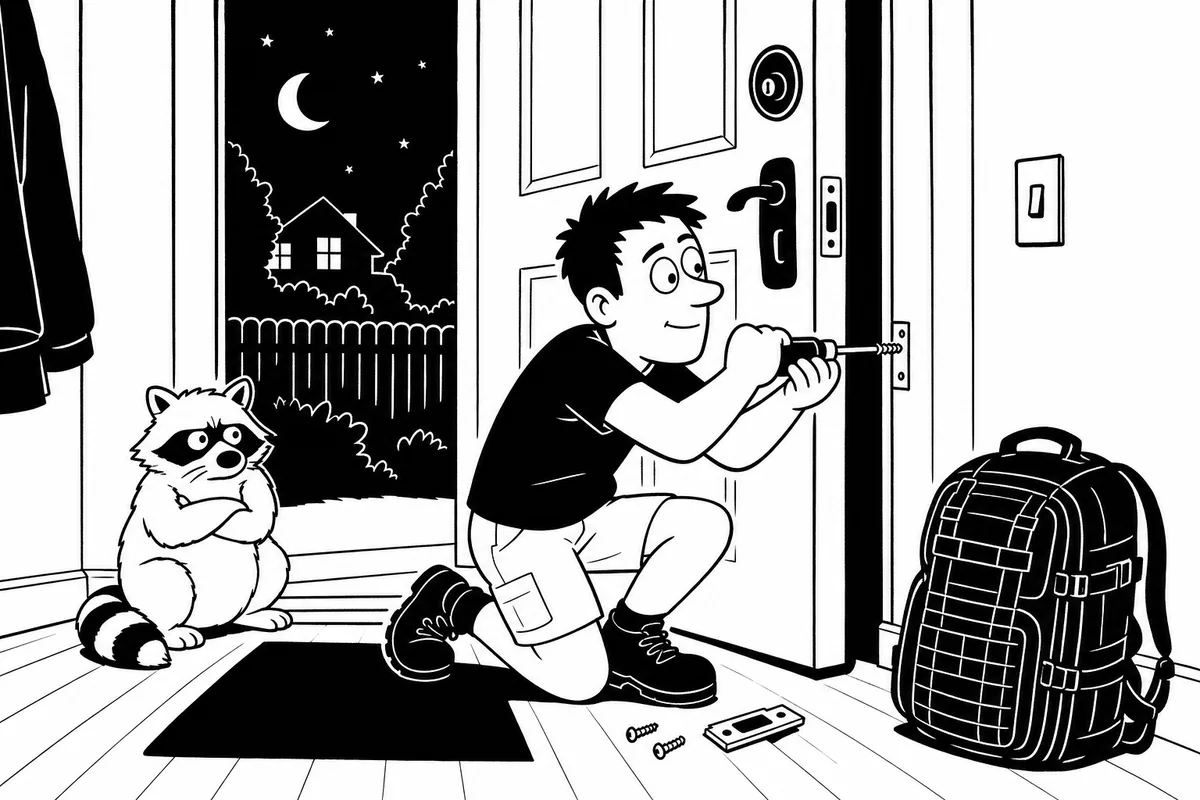
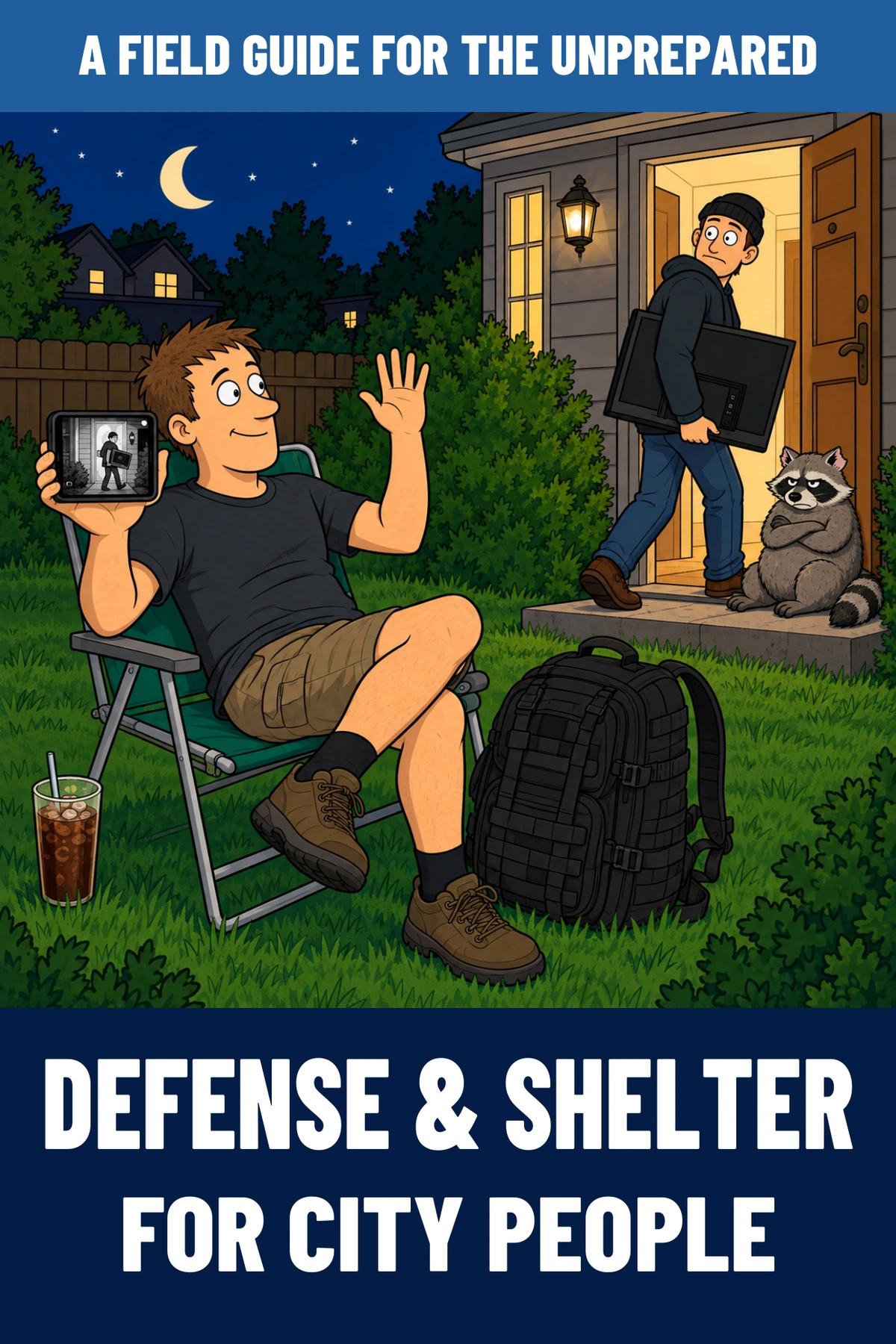
You have a seven-hundred-dollar tactical backpack and a door held shut by two half-inch screws.
Buying it for somebody else? Find their field guide.
5 things this book knows
Quoted from Defense & Shelter for City People exactly as printed. Every figure is the book’s own.
- A dog is a 10–15 year commitment, not equipment.
- A gallon weighs 8.3 pounds; the men packing six liters have confused a backpack with a well.
- Carry ~1 liter per person plus purification (tablets/filter); do not attempt to carry days of water.
- Pets: carriers, leashes, 3 days of food, vaccination records — and verify your likely shelter’s pet policy today, not during the event.
- Test smoke alarms monthly; replace alarms at 10 years; sleep with doors closed.
The reference cards, free
Straight out of this volume’s own appendix, which opens by telling the reader to photocopy it freely and laminate it shamelessly.
CARD 1 — DOOR-HARDENING CHECKLIST (with hardware names)
Total budget for the full protocol: roughly $150–300 per exterior door, one afternoon each. Do the front door first, then the garage-to-house door, then the back/slider.
The frame (do this first — most doors fail at the frame, not the lock): - [ ] Replace ALL strike plate screws with 3-inch #9 or #10 wood screws driven into the wall stud - [ ] Replace at least one screw per hinge with a 3-inch screw into the stud - [ ] Upgrade to a heavy-duty box strike (deep steel pocket, 4 screw holes) — or better: - [ ] Install a door reinforcement kit (continuous steel jamb channel + door edge wrap + hinge-side shield), ~$80–120
The lock: - [ ] ANSI/BHMA Grade 1 or Grade 2 single-cylinder deadbolt with a full 1-inch throw - [ ] Verify the bolt seats fully into the strike with the door naturally closed (no lifting/jiggling) - [ ] NO double-cylinder (keyed-inside) deadbolt where people sleep — fire egress outranks burglars, always
The door itself: - [ ] Exterior doors are solid-core (solid wood, fiberglass, or steel). Knock test: drum = hollow = replace the slab - [ ] Wide-angle peephole or viewer at a usable height; policy: unexpected knocks get a closed-door conversation
Sliders and windows: - [ ] Sliding door: rod or dowel in the track + anti-lift screws in the upper track - [ ] Ground-floor/fire-escape windows: pin locks or keyed sash locks, set to a 4-inch vent stop - [ ] EVERY bedroom keeps one openable exit; any bars or pins release from inside in under 5 seconds, in the dark
The approaches: - [ ] Motion-activated floodlights over every approach, mounted 8–10 ft, angled at the path - [ ] Dark corners, blocking shrubs at entries: trimmed or lit - [ ] Garage: zip tie through the overhead door’s emergency release lever hole; garage-to-house door gets the full door protocol
Renter’s no-drill version: portable door brace or security bar; track rod for sliders; wedge alarms ($10); plug-in motion lights; written landlord request for the screw-and-strike upgrade (“it improves the asset”).
The camera doorbell, in its place: buy it LAST, after everything above. It is a witness, not a wall.
The dog, in its place: the bark is the deterrent and any loud dog qualifies — but a dog is a 10–15 year family member, not equipment. Acquire for love, receive the security as the rebate; otherwise run the hardware above and be at peace.
CARD 2 — GO-BAG LIST, BY WEIGHT (target: under 20 lb; build ≈ 15)
| Item | Weight (approx.) |
|---|---|
| Boring, comfortable backpack (the one you own) | 2.0 lb |
| Water: 1 L bottle, filled | 2.2 lb |
| Purification: tablets or small filter | 0.2 lb |
| Food: ~2,000 kcal/day × 2 days, zero-cook (nut butter, jerky, bars you’ve actually eaten) | 2.0 lb |
| Medications: 7 days ALL prescriptions + written med/dose list + spare glasses | 1.0 lb |
| Compact first-aid kit (Book 5 build, not the decorative pouch) | 0.8 lb |
| The Folder copy set + USB stick (see Card 3) | 1.0 lb |
| Cash: $100–300 in tens, fives, ones | 0.0 lb |
| Headlamp + spare common batteries | 0.5 lb |
| Power bank (charged) + correct cables | 0.7 lb |
| Battery/crank radio (Book 7) | 0.5 lb |
| Paper map, routes marked + paper contact card | 0.2 lb |
| Full clothing change in gallon zip bag, incl. socks | 2.0 lb |
| Rain layer + seasonal warm layer | 1.5 lb |
| Walkable shoes — staged WITH the bag if your daily shoes are decorative | (worn) |
| Hygiene: wipes, travel kit, masks, earplugs | 1.5 lb |
| Morale: cards, paperback; per child: one comfort object (NOT optional) | 0.5 lb |
| TOTAL | ≈ 16.6 lb |
Modules as needed: infant (budget 5 lb, subtract elsewhere) · pet (leash, carrier, 3 days food, vaccination records) · work. Rules: one bag per adult; small bag per child (snack, comfort item, contact card). Mile test before you trust it. Lives by the door. Checked when the clocks change. Meds and papers outrank all gear, always.
CARD 3 — THE FOLDER (document grab-kit contents)
Identity: copies of licenses, passports, birth certificates, Social Security cards, immigration papers, marriage/custody documents · current printed photos of each family member and pet Money & ownership: insurance policies with claim numbers written large · deed or lease · vehicle titles · one recent statement per account · home walkthrough video (90 seconds/room, narrated, refreshed yearly, phone + cloud) Health: medication lists with doses and prescribers · allergies · vaccination records (human and animal) · insurance cards · pediatrician/vet numbers Access: spare house and car keys · master contact card · your dated self-defense-law consultation page (Ch. 5) Cash: small bills Digital echo: everything scanned to an encrypted USB clipped inside + one cloud copy (3-2-1: three copies, two media, one off-site) Storage: stages with the go-bags; originals that stay home live in a fire-RATED container — the rating is in minutes; read the label, believe the minutes. Updated on clock-change night.
CARD 4 — EVACUATION DECISION CARD *(no jokes on this card)*
THE TEST: Destination + Route + Reason = evacuation. Missing any one = you are not evacuating, you are camping badly during an emergency.
STAY (shelter in place) for: blackouts · boil advisories · supply disruptions · winter storms (in sound housing) · civil disturbance elsewhere in the city · most infrastructure events. Staying runs on: 14 gal water/person · 2 weeks no-cook food · heat-one-room plan · radio · meds · this folder.
GO for hazards with a vector (something physically coming to your address): - HOUSE FIRE — GO NOW. As little as 2 minutes. Possessions never. Out, stay out, meet, count, 911 from outside. - FLOOD — go at the VOLUNTARY notice. Never drive into water over a road: 6 inches of moving water knocks down an adult; 12 inches floats most cars. Turn Around, Don’t Drown. - WILDFIRE — Ready-Set-Go. Leave at SET if anyone in the household is slow-moving. Embers run a mile ahead. Never stay to defend property. - HURRICANE — run from water, hide from wind. Know your surge zone NOW. Go when your zone is called, not when the sky agrees. - CHEMICAL/HAZMAT or MANDATORY ORDER — official instructions override everything, including this book.
Pre-decided triggers (fill in, tape inside a cabinet): If county calls our zone → we leave that hour. If water reaches → we are already gone. If fire reaches → bags in car, car nosed out. If alarm sounds at night → out, meet, count, call.
Standing rules in any watch season: tank above half · phones charged · WEA alerts ON · bags staged · leave EARLY — early beats right; the cost of early is an afternoon; the cost of late is everything.
What each chapter comes down to
One line per chapter, in order — the book’s own summary of itself. The argument, the worked examples and the reasoning are in the volume.
- Awareness: The Head-Up DiscountMost street crime starts with an interview you can fail on purpose — head up, phone away at every transition, one earbud max, and let the baseline make anomalies loud. Awareness buys distance; distance buys everything else.
- Avoidance: The Best Fight Is ElsewhereRisk lives where late hours, dark empty routes, and impaired condition intersect — and all three are dials you set in advance. Decide at 2 p.m. what you’ll do at 2 a.m.; leave early; take the lit long way. Avoidance works silently or not at all, and silence is the win.
- De-escalation: Losing the Argument on PurposeSocial conflict runs on ego, and it takes two actors — so refuse your lines. Voice low and slow, agree cheaply, hands up and open, give him a door, name your exit, and leave without the parting shot. Walking away isn’t the consolation prize; it’s the win.
- Hardening: Your Door Is Lying to YouMost doors fail at the frame, not the lock — and $80 of screws, box strike, and reinforcement beats $2,000 of doorbell. Three-inch screws to the stud, Grade 1 deadbolt with a 1-inch throw, rod in the slider, lights on the approaches, and the dog only if you’ll love the dog. Cameras witness; frames argue.
- The Law: A Map, Not AdviceSelf-defense law is four elements everywhere — imminence, proportionality, innocence, reasonableness — with retreat, stand-your-ground, and castle rules varying wildly by state. Deadly force never defends mere property, the aftermath is part of the fight, and the only competent legal advice in this book is: know YOUR state, and buy one hour with a real lawyer, now, before.
- Tools, Last: The Chapter You Skipped Ahead ToEvery tool passes one gate — lawful, trained-with, stored safely — or stays in the store. Pepper spray (gel, carried in reach, replaced every 3–4 years) is the underrated civilian answer; the flashlight and the alarm punch above their weight; and a firearm is the Four Rules, professional training, a locked safe, and your local law, or it is nothing at all.
- Stay or Go: The Bug-Out ChapterStaying is usually right — a provisioned home (two weeks food and water, heat, light, radio, meds, documents) beats the road in almost every real disruption. Leave only for hazards with a vector — fire, flood, surge, chemical, mandatory orders — and apply the test: destination + route + reason = evacuation. Missing any one, it’s camping, badly.
- The Go-Bag That Isn’t CosplayA go-bag has one job — you, safely, to a real destination for 1–3 days — and one enemy: weight. Fifteen to twenty pounds, boring bag, built on meds, documents, glasses, cash, water treatment, no-cook calories, light, radio, and walkable shoes. Then the mile test, staged by the door, checked when the clocks change. Pills and paper outrank every piece of gear ever sold.
- Leaving Early: Evacuation for the Disasters That Actually HappenThe real disasters are fires, floods, and storms, and they all trade time for survival at the same rate — best at the start. Alerts layered, zones known, triggers written in advance, tank half full, and the entire secret in two words: leave early. Six inches of moving water takes your feet; twelve floats your car; two minutes empties a burning house. Early beats right, every single time.
- The Plan: Routes, Meetups, the Folder, and Drills That Aren’t WeirdThe plan is one page: two driving routes in different directions plus one on foot, three meetup tiers (near for fires, mid for blocks, far with a confirmed destination), an out-of-area text switchboard on paper in every pocket, and the Folder — identity, insurance, meds, keys, cash, USB. Practice it twice a year, announced, timed, ending in pizza. Boring at the mailbox is victory.
- The Door at Doreen’s HouseEverything this book taught — the door, the plan, the folder, the drill — is one sentence in the end: I thought about the worst night of your life before it happened, because I love you. Say it in words if you can. Say it in hardware regardless. It keeps saying itself long after you’ve gone home.
Common questions
Which door should I reinforce first?
The front door, then the garage-to-house door, then the back door or slider. The garage door is the one people forget, and it is often the weakest way into an otherwise careful house.
What should be in a go-bag, and how heavy should it be?
Under 20 lb, built to about 15. Water and a means to purify it, two days of zero-cook food, seven days of all prescriptions with a written dose list and spare glasses, a compact first aid kit, the document folder, $100–300 in small notes, and a headlamp with spare cells.
What documents should I copy in advance?
Identity: licences, passports, birth certificates, immigration and custody papers. Money: insurance policies with claim numbers written large, deed or lease, vehicle titles. Health: medication lists with doses and prescribers, allergies, vaccination records. Plus a narrated 90-second walkthrough video of each room, refreshed yearly.
What this book is not
It is a field guide, not a medical, legal or structural authority. Where a mistake maims or kills, the book stops joking and says so on the page; this site does the same. Nothing here replaces emergency services, a physician, a licensed tradesperson, or the law where you live.
This edition
| Series | For City People, volume 9 of 10 |
| Pages | 224, 6 × 9 in |
| Illustrations | 27, drawn for this book |
| Words | 35,890 |
| Paperback | 979-8-90623-271-7 |
This page is a reference, not an authority. It is field-guide material, not medical, legal, electrical or structural advice, and nothing on it replaces emergency services, a physician, a licensed tradesperson, or the law where you live.
No plant is edible on the say-so of a web page. In a real emergency the first instruction is to call for help. Local code outranks any page here.
Dr. Buck Savage is a fictional narrator and is not a doctor. The reference material is real and is drawn from the published books; the man is not.
Department of tactful suggestions / volume 09
Someone came to mind.
Send them a field guide. Let the cover do the explaining.