Volume 08 of 10 · For City People
Engines & Transport
That Light Has Been On Since 2024
What should I check on my car every week?
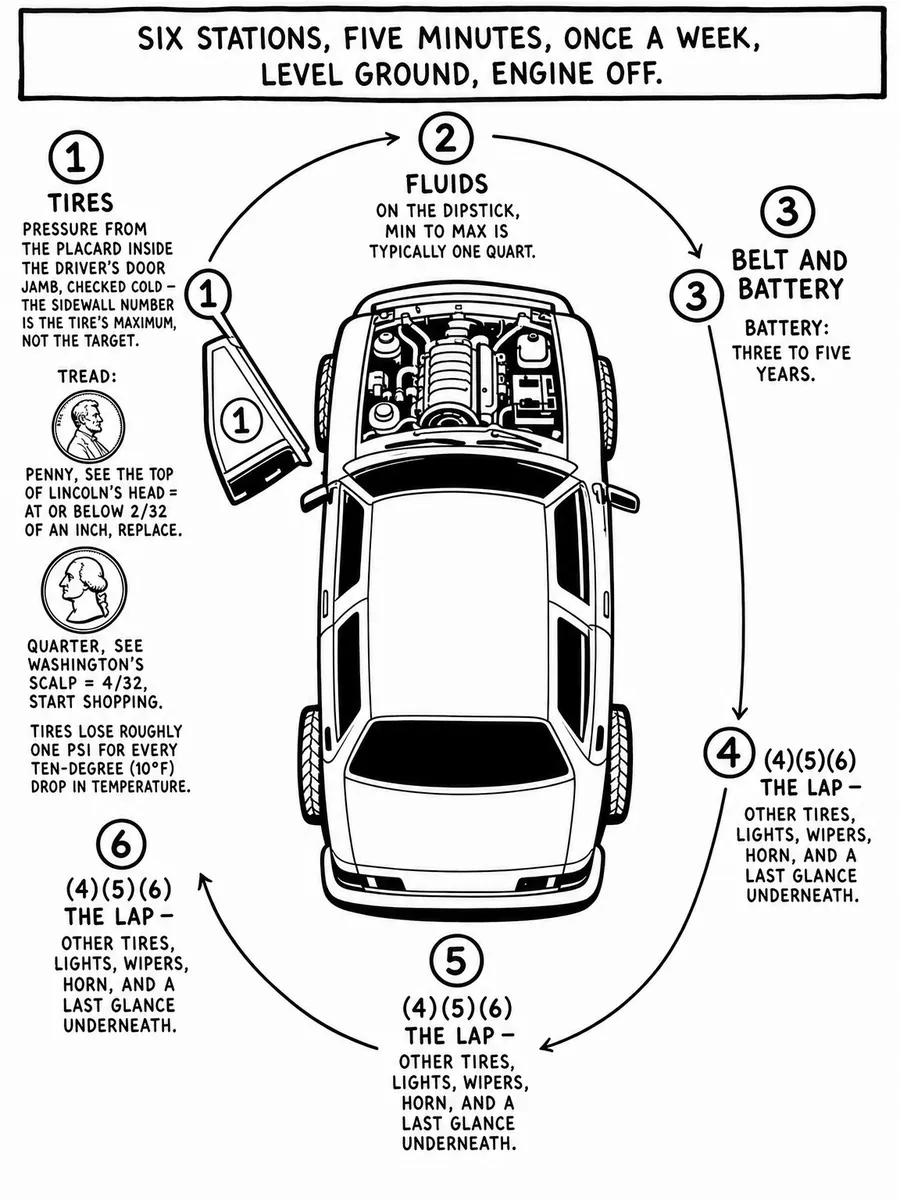
Five minutes, level ground, engine off and cold. Tyre pressure with a gauge, to the door-jamb placard and never the sidewall maximum. Penny in the tread — all of Lincoln's head visible means you are at 2/32" and replacing. Oil between the marks. Hands round each sidewall: a bubble is replace-today, and not repairable.
From Engines & Transport for City People by Dr. Buck Savage†. 198 pages · 21 illustrations.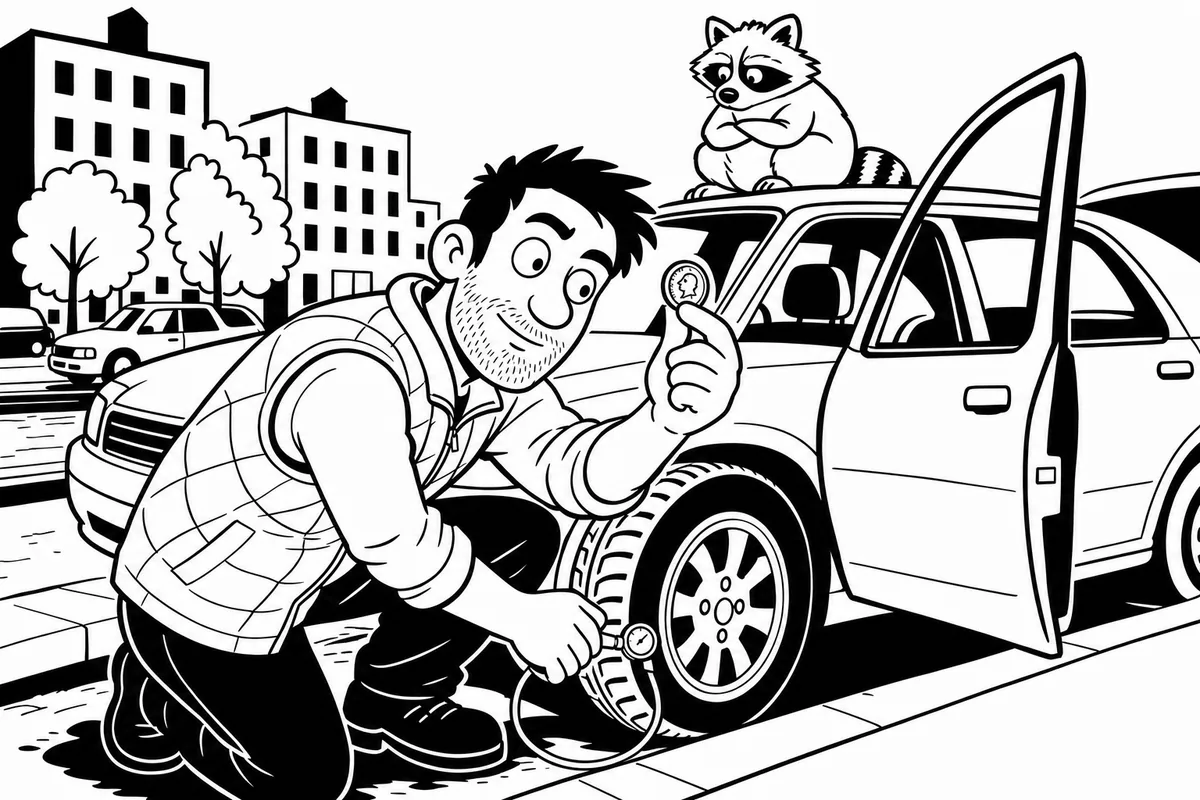

It’s been on since 2024. You’ve stopped seeing it. It hasn’t stopped meaning something.
Buying it for somebody else? Find their field guide.
5 things this book knows
Quoted from Engines & Transport for City People exactly as printed. Every figure is the book’s own.
- If your spare is a space-saver — the skinny humiliating one — it has two commandments printed right on it: 50 miles per hour, maximum, and roughly 50 to 70 miles of total service life.
- Drive 20–30 minutes, then have it tested — free at most parts stores — and replace on the verdict.
- Your refrigerator might run on 700 watts and demand 2,000-plus for the moment of startup.
- Plan crisis range at 60 to 70 percent of the sticker — weather, detours, load, and gridlock tax every drivetrain ever built.
- Load cargo low, centered, and strapped; respect the ratings (racks ~25–50 lb, most trailers ~100 lb).
The reference cards, free
Straight out of this volume’s own appendix, which opens by telling the reader to photocopy it freely and laminate it shamelessly.
THE WEEKLY WALKAROUND (wallet card — same orbit, every time)
Weekly, level ground, engine off and cool. Five minutes.
-
TIRES (all four): pressure with a gauge, COLD, to the door-jamb placard (never the sidewall max). Penny in the groove — see all of Lincoln’s head = at/below 2/32”, replace. Quarter test = 4/32”, start shopping. Hands around each sidewall: bubbles = replace today, no repair. Look for nails, uneven wear.
-
OIL: pull, wipe, seat, pull, read between marks (MIN→MAX ≈ 1 quart). Honey/brown = fine; milky = mechanic this week. Top with the grade on the cap, half-quart steps.
-
COOLANT: read level through the overflow tank. Never open any cap hot.
-
BRAKE FLUID: read only. Falling fast or near MIN = no driving until diagnosed.
-
BELT: cracks, glaze, fray; squeal at startup = this week.
-
BATTERY: clean terminals, tight hold-down, know its birth date (3–5 yr life; test from year 3).
-
LIGHTS/WIPERS/HORN/WASHER: brake lights and signals via helper or window reflection; wiper edges; honk once.
-
GROUND CHECK: new spots under the car — black = oil, sweet orange/pink/green = coolant (toxic to pets — clean fully).
Monthly extras: spare tire pressure · engine air filter to the light · leaves out of the cowl drains. Rules of thumb: tires lose ~1 psi per 10°F drop · red oil/brake/temp lights = pull over, engine off, now.
THE JUMP-START SEQUENCE (this card is deliberately joke-free)
Before connecting: Both cars OFF, keys out, close but not touching. Parking brakes set. No jump if either battery is cracked, leaking, bulging, or possibly frozen — replace instead. Rings and metal watches off. Know where every clamp is at all times; clamps never touch each other. Your owner’s manual outranks this card — use dedicated jump posts if provided; follow hybrid/EV procedures; some vehicles must not give or receive jumps.
CONNECT, in this exact order: 1. RED → DEAD battery positive (+) 2. RED → LIVE battery positive (+) 3. BLACK → LIVE battery negative (−) 4. BLACK → bare metal on the DEAD car’s ENGINE BLOCK or marked ground point — never the dead battery’s negative post. (The last connection sparks; batteries vent flammable hydrogen; the spark must happen away from the battery.)
Then: start donor, run 2–3 minutes → start dead car → if weak, wait 5 minutes and retry → ten minutes of failure = stop; the problem is beyond a jump.
DISCONNECT in exact reverse: 4 → 3 → 2 → 1. No clamp touches anything until all four are off.
After: drive 20–30 minutes, then have the battery TESTED (free at most parts stores). A battery that needed one jump has testified. Face away from the battery on the final connection; eye protection if available.
Better tool: lithium jump pack with polarity protection — keep charged, recheck quarterly.
TIRE CHANGE QUICK SEQUENCE
Flat, firm ground, away from traffic (drive on the flat to get there — rims are replaceable) → hazards, parking brake, everyone out and away → chock the diagonal wheel → find spare, jack, wrench, locking-lug key → crack lugs BEFORE lifting (one turn) → jack at the marked jack point → lift until the flat clears by a few inches → lugs off, wheel off, slide the flat under the sill → spare on, all lugs threaded by hand → snug in a STAR pattern → lower fully, jack out → final-tighten in the star, full two-hand effort (~80–100 lb-ft typical) → re-check lugs at ~50 miles.
-
Never any part of your body under a car held only by a jack. Ever.
-
Donut spares: 50 mph max, 50–70 miles total. Check spare pressure quarterly (donuts often spec ~60 psi — printed on the spare).
-
Blowout at speed: don’t brake hard — grip, off the gas, hold the lane, slow, then pull off.
-
Sidewalls and bubbles are never repairable; plugs/patches are for small tread punctures, shop-confirmed.
CHECK ENGINE LIGHT — READ THIS BEFORE PAYING ANYONE
-
STEADY = a memo. Read the code within the week. Drivable.
-
FLASHING = active misfire destroying the catalytic converter. Slow down, no hard throttle, shop TODAY (tow if shuddering).
-
Red lights (oil pressure / brake / temp / charging) are not CELs — pull over, engine off, now.
-
OBD-II port: under the dash, driver’s side, every gas car sold in the US since 1996. Reader: $20–40, or Bluetooth dongle + free app. Parts stores often scan free. Typical shop “diagnostic fee” for the same read: $100–180.
-
Common codes: P0455/P0442/P0457 = EVAP leak → tighten/replace gas cap first · P030X = misfire, X names the cylinder (plugs → coils → deeper) · P0420/P0430 = catalyst efficiency (get professional confirmation before buying parts) · O2 sensor codes = the witness, not always the culprit.
-
A code is a symptom, not a sentence. Clear-and-watch is legitimate for non-urgent codes; clearing to dodge inspection is not (monitors reset; stations can tell).
-
Never buy a used car without scanning it. Freshly wiped codes are information.
GENERATOR SIZING WORKSHEET
Method: list only what must run at once → sum RUNNING watts → add the single LARGEST starting surplus (start big motors one at a time) → buy ≥20% above the total.
| Appliance | Running W | Starting W |
|---|---|---|
| Refrigerator | 600–800 | 1,200–2,200 |
| Chest freezer | 300–500 | 900–1,500 |
| Furnace blower | 700–800 | 1,400–2,300 |
| Sump pump | 800–1,000 | 1,300–2,900 |
| Window AC | 900–1,200 | 1,800–2,700 |
| LED bulb | ~10 | — |
| Phone / router / laptop | 10 / 15 / 60 | — |
Filled example: fridge 700 + freezer 400 + lights 50 + comms 50 + blower 750 = 1,950 running → +1,400 (fridge surge gap) = 3,350 → ×1.2 ≈ 4,000 W unit. Drop the blower and a 2,000-class inverter (or two paralleled) covers refrigeration + light + comms.
My list: Running total: + largest surge: ×1.2 = W
Fuel: mid-size conventional at half load ≈ 0.5–1 gal/hr → duty-cycle in blocks (fridge/freezer chill hard, then rest). Stabilizer in every can the day it’s filled (untreated E10 degrades in 30–90 days; stabilized ≈ a year). Approved cans, detached/outdoor storage, fire-code limits (commonly ~25 gal — verify locally). Rotate cans through the car each clock-change weekend; date with paint pen. Refuel only off and cooled.
⬛ THE CO BOX — READ FIRST, EVERY SEASON: Generators run OUTDOORS ONLY, 20+ feet from every door, window, and vent, exhaust pointed away. Never a garage (open or closed), carport, porch, breezeway, or basement. Battery CO alarms on every sleeping level, tested monthly — bought on the generator’s receipt. Alarm or symptoms (headache, dizziness, nausea, confusion) = everyone out, fresh air, 911, say “carbon monoxide.” Never backfeed a wall outlet — transfer switch, interlock, or direct rated cords (12-gauge for heavy loads) only. Generator CO kills more people after some storms than the storms do.
What each chapter comes down to
One line per chapter, in order — the book’s own summary of itself. The argument, the worked examples and the reasoning are in the volume.
- The Walkaround: Five Minutes Between You and the ShoulderFive minutes, once a week, same orbit every time — tires to the door-jamb number, fluids read like instruments, belt, battery, lights. The car always confesses before it fails. Your only job is to attend the confession.
- The Tire: Changing It Without an App or an AudienceFlat ground before anything, lugs cracked before lifting, spare snugged in a star, torqued after lowering, re-checked at 50 miles — and no part of you, ever, under a car held only by a jack. Rehearse it once in a driveway and a flat becomes a chore instead of an event.
- The Battery: Dead Is a Diagnosis, Not a PersonalityBatteries die in August and confess in January — test at year three, replace by year four, on your schedule. And the jump order is one idea in four steps: dead positive, live positive, live negative, engine-block ground — because the last clamp always sparks, and the spark must happen nowhere near the hydrogen.
- That Light Has Been On Since 2024Steady light = a memo — read the code this week with your own $25 reader. Flashing light = an active misfire cooking your catalytic converter — reduce load and get help today. The code is a case number, not a curse; the diagnostic fee is for wisdom, not for the eleven seconds of reading you can do yourself.
- The Crisis Car and the Half-Tank ReligionBelow half is empty — pumps need power, lines eat hours, and evacuation math starts at your current needle. A crisis car is an ordinary car that starts, stops, sits above half, and carries one boring bag you check on the clock-change weekends.
- Generators, At LastSize for the triage list — sum the running watts, add the single largest surge, buy 20 percent over — duty-cycle the runtime, stabilize and rotate the fuel, and site the machine like lives depend on the tape measure, because they do: outdoors only, 20-plus feet out, exhaust away, CO alarms on every sleeping level.
- Small Engines Die of the Same Three ThingsEvery small engine dies of stale fuel, dirty air, or neglected oil — stabilize every can, run machines dry for storage, check the filter, change oil every 25–50 hours. The saw gets chaps, helmet, a working chain brake, and a course before the storm. And the fuel reserve you can actually siphon is the one you stored in cans.
- Evacuation: The Day the Road Becomes a Parking LotEvacuation is won or lost days early — set your go/no-go trigger in calm weather, leave before the rush or shelter well on purpose, carry two paper routes and a tank above half, and never put a wheel into water on a road: twelve inches floats a car, and the road underneath may already be gone.
- The Cockroach and the Appliance: Bicycles and EVsThe bicycle is the vehicle the crisis can’t touch — no fuel, no plates, no gridlock, 100 pounds on a trailer, thirty seconds of ABC — and the EV is neither savior nor scam: full-from-home and gridlock-proof, but grid-dependent and queue-prone. Plan any vehicle’s crisis range at 60–70 percent of the sticker, and remember the only powertrain that fails every scenario: the empty one.
- Why The Truck StartsMachines fail gradually, invisibly, and then suddenly — and maintenance is simply being present for the gradual part. It is a promise made with a rag to people who aren’t there yet. Keep it weekly. The person who checks the oil is the person who meant it.
Common questions
What order do jump leads go on?
Red to the dead battery's positive, red to the live battery's positive, black to the live battery's negative, then black to bare metal on the dead car's engine block or a marked ground point — never the dead battery's negative post. The last connection sparks, and batteries vent flammable hydrogen, so the spark has to happen away from the battery. Disconnect in exact reverse. Your owner's manual outranks any card.
How do I know when a tyre needs replacing?
Put a penny in the tread groove head-first. If you can see all of Lincoln's head, you are at or below 2/32" and it needs replacing now. A quarter test showing the whole head is 4/32" — start shopping. Any sidewall bubble is replace-today and cannot be repaired.
What does milky oil on the dipstick mean?
See a mechanic this week. Honey or brown oil between the MIN and MAX marks is fine; milky is not. The gap between MIN and MAX is roughly one quart — top up half a quart at a time with the grade printed on the cap.
What this book is not
It is a field guide, not a medical, legal or structural authority. Where a mistake maims or kills, the book stops joking and says so on the page; this site does the same. Nothing here replaces emergency services, a physician, a licensed tradesperson, or the law where you live.
This edition
| Series | For City People, volume 8 of 10 |
| Pages | 198, 6 × 9 in |
| Illustrations | 21, drawn for this book |
| Words | 33,196 |
| Paperback | 979-8-90623-269-4 |
This page is a reference, not an authority. It is field-guide material, not medical, legal, electrical or structural advice, and nothing on it replaces emergency services, a physician, a licensed tradesperson, or the law where you live.
No plant is edible on the say-so of a web page. In a real emergency the first instruction is to call for help. Local code outranks any page here.
Dr. Buck Savage is a fictional narrator and is not a doctor. The reference material is real and is drawn from the published books; the man is not.
Department of tactful suggestions / volume 08
Someone came to mind.
Send them a field guide. Let the cover do the explaining.