Volume 07 of 10 · For City People
Comms & Electronics
Your Phone Is About to Become a $1,200 Flashlight
What radio should I get for emergencies?
GMRS for most households: about $35 for ten years, no exam, and the licence covers your immediate family. It reaches 1–5 miles direct, or tens of miles through a repeater. FRS is free and unlicensed but tops out at 0.5–2 miles. The ham Technician exam is 35 questions, 26 to pass, from a published pool, with no Morse code.
From Comms & Electronics for City People by Dr. Buck Savage†. 198 pages · 13 illustrations.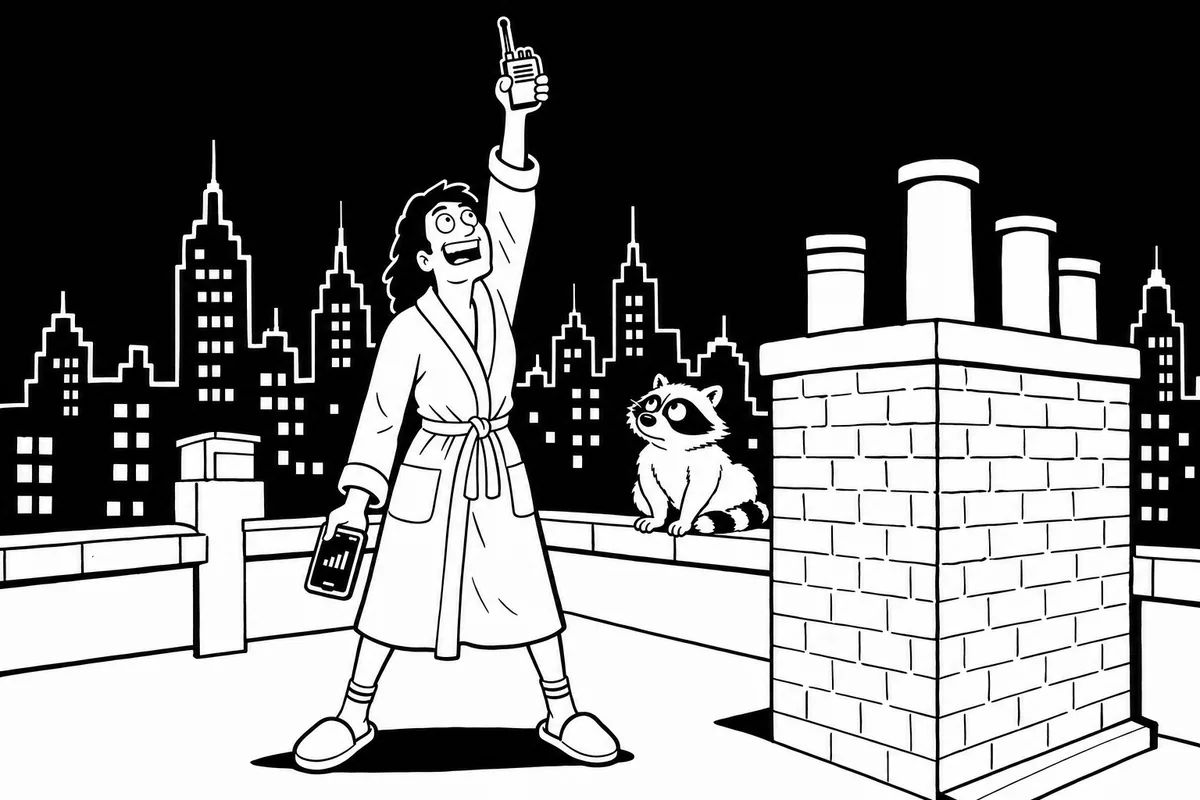
The tower is a building on a battery.
Buying it for somebody else? Find their field guide.
5 things this book knows
Quoted from Comms & Electronics for City People exactly as printed. Every figure is the book’s own.
- Five channels down in VHF (around 151–154 MHz), 2 watts, license-free like FRS — but with external antennas allowed, which changes everything for fixed use.
- When your practice average holds around 80–85 percent, you pass the real thing; the pool is finite and your brain is a professional pattern-matcher that has been bored since college.
- For $25–35 you get a real dual-band (2 m / 70 cm — the two workhorse VHF/UHF bands where all local ham life happens) handheld transceiver putting out around 4–5 watts.
- A device that draws 10 watts for 3 hours has spent 30 watt-hours.
- Convert to reality: mAh × 3.7 volts ÷ 1,000 = watt-hours.
The reference cards, free
Straight out of this volume’s own appendix, which opens by telling the reader to photocopy it freely and laminate it shamelessly.
THE PACE PLAN — FILL-IN TEMPLATE (Ch. 2)
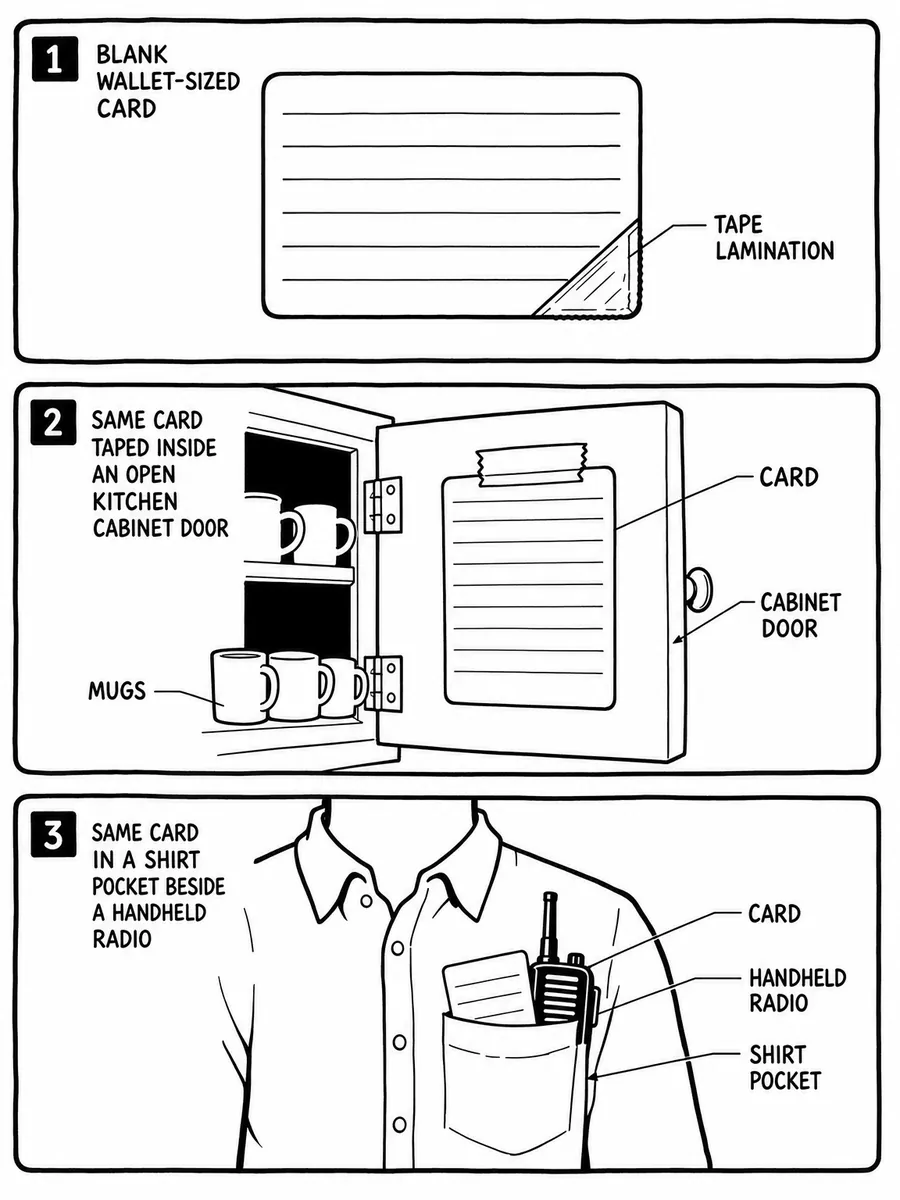
One per family. Complete it, copy it wallet-sized for every member, tape one inside a kitchen cabinet, send one to the out-of-area contact. Laminate or packing-tape everything.
P — PRIMARY (normal networks) - Family text thread / numbers: - Message format: STATUS / LOCATION / PLAN / NEXT CHECK-IN (“OK. Office. Walking home via 5th. Next msg 8pm.”) - Rule one: in any regional event, TEXT, don’t call. Short, informative, timestamped.
A — ALTERNATE (out-of-area contact = the family switchboard) - Name: Location: - Phone (voice): (text): Email: - Has agreed to the job: ☐ Holds current copy of this plan: ☐ - Everyone reports IN to the contact; everyone gets news FROM the contact. No lateral calling storms.
C — CONTINGENCY (phones down → radios) - Family radio service: FRS ☐ GMRS ☐ (license # ) Ham ☐ - Family channel: Fallback channel: (both written on every radio: ☐) - Simplex/mesh backup: - Check-in windows: at / / / (10 minutes each, radios/phones off between) - Missed-window rule: try next window; escalate only after TWO missed.
E — EMERGENCY (nothing electronic works) - NEAR rally point (walkable, exact spot): - FAR rally point (outside neighborhood): - Note-leaving spot at home: (format: WHO / WHEN / WHERE / NEXT) - School release policies checked & pickup adults listed: ☐
Memorized numbers (minimum 3 per person, recited cold): 1. 2. 3. Drill dates (twice yearly, tied to clock changes): / Last drilled:
THE SERVICES — ONE-CARD COMPARISON (Ch. 3–4)
| Service | License | Cost | Power | Antennas | Real-world range | Best use |
|---|---|---|---|---|---|---|
| FRS | None | $0 | 2 W (0.5 W ch. 8–14) | Fixed | 0.5–2 mi | Family, buildings, convoys; hand to anyone |
| GMRS | FCC, no test | ~$35 / 10 yr, covers immediate family | 5 W handheld; up to 50 W mobile/base | Detachable, roof/mast OK | 1–5 mi direct; tens of mi via repeater | The family network; PACE Contingency layer |
| MURS | None | $0 | 2 W | External allowed | 1–3+ mi, better in open country | Quiet fixed/rural/base use; the sleeper |
| Ham (Technician) | FCC exam: 35 questions, 26 to pass, public question pool | ~$15 session + $35 FCC / 10 yr | Up to legal limit (handhelds ~5 W) | Anything lawful | Metro-wide via repeaters; regional+ | The endgame: repeaters, nets, community |
| (CB — footnote) | None | $0 | 4 W AM | External allowed | 1–5 mi, noisy | Highway culture; Book 8’s department |
Notes: FRS/GMRS share channels and interoperate. “Privacy codes” (CTCSS/DCS) mute your speaker; they hide nothing. Verify current fees/rules: fcc.gov (Part 95 for FRS/GMRS/MURS; Part 97 for amateur).
THE TECHNICIAN STUDY PATH (Ch. 4)
The facts: 35 multiple choice · pass at 26 (74%) · every question from a published public pool (~400+ questions, refreshed on a multi-year cycle) · no Morse code · license good 10 years.
The two-week commuter plan: - Day 1: Take a free practice exam COLD. Score is irrelevant; starting is the point. - Days 2–5: Free flashcard site (search “ham practice exam” — hamstudy-type sites track weak areas), 20–30 min/day. Study what you MISS. - Days 6–10: One practice exam daily + review misses. Formulas: E = I × R; wavelength ≈ 300 ÷ MHz. That’s most of the math. - Days 11–13: Practice average holding 80–85% = you’re ready. - Day 14: Exam session.
Before exam day: create FCC account, get FRN number (free, fcc.gov). Bring: photo ID, FRN, session fee (~$15), pencil, calculator (non-programmable OK). Find a session: ARRL exam-session search, or your local club (search “[your city] amateur radio club”). Online proctored sessions exist. After passing: pay the $35 FCC application fee promptly; transmit only once your callsign appears in the FCC database (check the ULS lookup). Weekend option: one-day “ham cram” courses — study morning, test afternoon, licensed by dinner.
FIRST-CONTACT SCRIPT CARD (Ch. 6)
-
Listen to the repeater until you know its rhythm. Days is fine.
-
Key, pause a half-beat, then: “[Your callsign], monitoring.”
-
Someone answers → exchange: name, rough location, signal report, “first contact.” They will be delighted. Let them be.
-
ID with your callsign every 10 minutes and at the end. (Law.)
-
Wait for the courtesy beep + a beat between overs — gaps are where emergencies break in.
-
Sign off: “[Their callsign], [your callsign], 73.” (73 = best regards.)
Signal reports: “Five nine” = perfectly readable, strong (RST). FM repeater dialect: “full quieting” (perfect) / “scratchy” / “picket-fencing” (mobile flutter). Give honest reports. National simplex calling frequency: 146.52 MHz. Repeater offsets: 2 m ±600 kHz; 70 cm ±5 MHz; tone (CTCSS) per directory — wrong tone = silence, check it twice. Net check-in: wait for “visitors or new check-ins” → phonetics, slow: “[callsign], [name], first check-in.” State “no traffic” unless you have some. Come back next week. Attendance is the skill.
PHONETIC ALPHABET: Alfa Bravo Charlie Delta Echo Foxtrot Golf Hotel India Juliett Kilo Lima Mike November Oscar Papa Quebec Romeo Sierra Tango Uniform Victor Whiskey X-ray Yankee Zulu. Digits: say each (“one four six”).
THE LISTENING LAYER CARD (Ch. 7)
NOAA WEATHER RADIO (buy this first): - 7 frequencies: 162.400 · 162.425 · 162.450 · 162.475 · 162.500 · 162.525 · 162.550 MHz - My transmitter/frequency: (map: weather.gov/nwr) - My county SAME code: (+ upwind neighbors: ) - Setup: program SAME code(s) → enable battery backup → fresh batteries yearly → confirm the weekly on-air test: ☐ - Alert modes: choose tone-then-voice. Never fully silence it. It cannot be colonized by mattress companies.
SCANNER: check your county’s systems FIRST (online scanner-reference databases) — analog is cheap; digital/trunked capable costs real money; encrypted is unreceivable, full stop. State law on mobile/vehicle scanner use checked: ☐ SHORTWAVE: $40–90 portable, SSB capability if you want the ham bands. Listen at night; lower frequencies run long after dark. Time stations: WWV at 2.5 / 5 / 10 / 15 / 20 MHz. Wire antenna toward a window. THE LAW (cold): listening to unencrypted public airwaves is broadly legal. Transmitting without the appropriate license is a federal violation — five-figure forfeitures. Sole exception: immediate threat to human life with no normal means available. The license is about $50 and a weekend. Get the license.
What each chapter comes down to
One line per chapter, in order — the book’s own summary of itself. The argument, the worked examples and the reasoning are in the volume.
- The Tower Is a Building on a BatteryThe cell network dies early and on schedule — congestion in minutes, tower batteries in hours (commonly two to eight), rescue towers in days. In the gap: text don’t call, one designated contact, Wi-Fi calling on, airplane-mode discipline, and 911 kept sacred.
- PACE Yourself: The Family Plan That Isn’t a Billing TermBuild the PACE plan — text-first Primary, out-of-area Alternate as the family switchboard, radio Contingency with fixed check-in windows, physical Emergency rally points and notes — put it on wallet cards, memorize three numbers, and drill it twice a year until it’s a bit.
- Walkie-Talkies Without the MarketingFRS is license-free and honest at a half mile to two miles — own a charged pair. GMRS is the family’s real network: $35, ten years, no test, covers the household, real antennas and repeater range. MURS is the quiet VHF sleeper for fixed and rural use. And “36 miles” is a mermaid.
- The License: 35 Questions Between You and the EndgameThe Technician exam is 35 multiple-choice questions, 26 to pass, drawn from a free public question pool — a take-home you’re allowed to memorize. About $50 all-in for ten years, no Morse required, passable in a weekend of free practice exams. A teenager does it between soccer games; you went to grad school. Go.
- Your First Radio (and the Penthouse Gossip)First radio: the $25 handheld if the price is what gets you started, the $100 one if you already know you’ll stay. Program it by cable and software with every local repeater — offset and tone — BEFORE the emergency. The repeater is the penthouse gossip on emergency power: whisper to her, she shouts to the county. And spend your next $20 on the antenna, not the radio.
- Keying Up: First Contact Without Dying of Stage FrightListen first, then key up and say “[callsign], monitoring” — the exchange is just names, signal reports, and welcome; ID every 10 minutes and at the end; phonetics are armor; 146.52 simplex is the knock-on-any-door channel. Then find your Tuesday net and check in weekly: a net is a drill that doesn’t know it’s a drill, and attendance is the skill.
- The Listening LayerBuild the listening layer: a $30 NOAA weather radio with your county’s SAME code and battery backup (the one purchase this book insists on), a scanner sized to your county’s actual systems, and a $40 shortwave set for when the horizon is the only network left. Receiving is legal, free, and unkillable. Transmitting takes the license — and the license takes a weekend.
- Watts and Hours: Keeping the Rectangle AliveWatts are the spending rate, watt-hours the account: a phone is only 10–15 Wh, a 10,000 mAh bank is ~2 real charges, and a “100 W” panel honestly aimed pays 50–70 W in full sun — 250–400 Wh a day. Budget loads first, then storage, then panels; charge USB from USB; fund medical devices first; and obey the lithium rules like the fire code they are.
- The Mesh and the PaperBuild the two towerless layers: a license-free LoRa mesh node per household — rooftop nodes, shared channel, block-scale texts that hop past any outage — and the paper spine: contact sheets in every wallet, three numbers memorized cold, a waterproof document sleeve with an encrypted USB twin, printed maps and routes, small bills, and one print-day a year. The heart emoji does not store digits.
- EMP: The Physics and the Fan-FictionSolar storms are real, grid-scale, and forecast days ahead (Carrington 1859, Québec’s 90-second collapse in 1989 — bookmark NOAA’s SWPC); they threaten long wires, not your pocket. HEMP is real physics whose scenario makes your gadgets a footnote. Prepare for the near-certain outages first — the same stack covers every tail — and if you want a Faraday hedge, it’s a $25 trash can, not a $400 duffel.
- THE SINCERITY: Five NineThe payload was never information. It’s the carrier — a fixed hour, a kept frequency, a station that answers. Build the skills so that when somebody you love sends NOT OK, at whatever speed they can afford, you copy all of it — and they are always, always five nine at your end.
Common questions
Do I need a licence for a two-way radio?
FRS and MURS need none and cost nothing, at 2 W and short range. GMRS needs an FCC licence — about $35 for ten years, no test, and it covers your immediate family. Ham requires passing an exam.
How hard is the ham radio Technician exam?
35 multiple-choice questions, 26 correct to pass — 74%. Every question comes from a published public pool of 400-odd, refreshed on a multi-year cycle. There is no Morse code requirement, and the licence lasts ten years.
What is a PACE plan?
Primary, Alternate, Contingency, Emergency — four ways to reach your family, ranked. Primary is the normal network, and in a regional event you text rather than call: status, location, plan, next check-in. Alternate is an out-of-area contact acting as the family switchboard.
What this book is not
It is a field guide, not a medical, legal or structural authority. Where a mistake maims or kills, the book stops joking and says so on the page; this site does the same. Nothing here replaces emergency services, a physician, a licensed tradesperson, or the law where you live.
This edition
| Series | For City People, volume 7 of 10 |
| Pages | 198, 6 × 9 in |
| Illustrations | 13, drawn for this book |
| Words | 35,467 |
| Paperback | 979-8-90623-267-0 |
This page is a reference, not an authority. It is field-guide material, not medical, legal, electrical or structural advice, and nothing on it replaces emergency services, a physician, a licensed tradesperson, or the law where you live.
No plant is edible on the say-so of a web page. In a real emergency the first instruction is to call for help. Local code outranks any page here.
Dr. Buck Savage is a fictional narrator and is not a doctor. The reference material is real and is drawn from the published books; the man is not.
Department of tactful suggestions / volume 07
Someone came to mind.
Send them a field guide. Let the cover do the explaining.