Volume 06 of 10 · For City People
Hunting & Fishing
The Fish Doesn’t Know You Have a Master’s Degree. Neither Does the Deer.
How do I start hunting or fishing legally?
Everything runs through your state wildlife agency: the licence, the season dates, the tags and the current regulations booklet — bought from the official .gov domain, because third-party lookalike sites upcharge. Then the four firearm rules, kept by everyone present, all of the time. Tags are validated at the kill site, before the animal is moved.
From Hunting & Fishing for City People by Dr. Buck Savage†. 198 pages · 14 illustrations.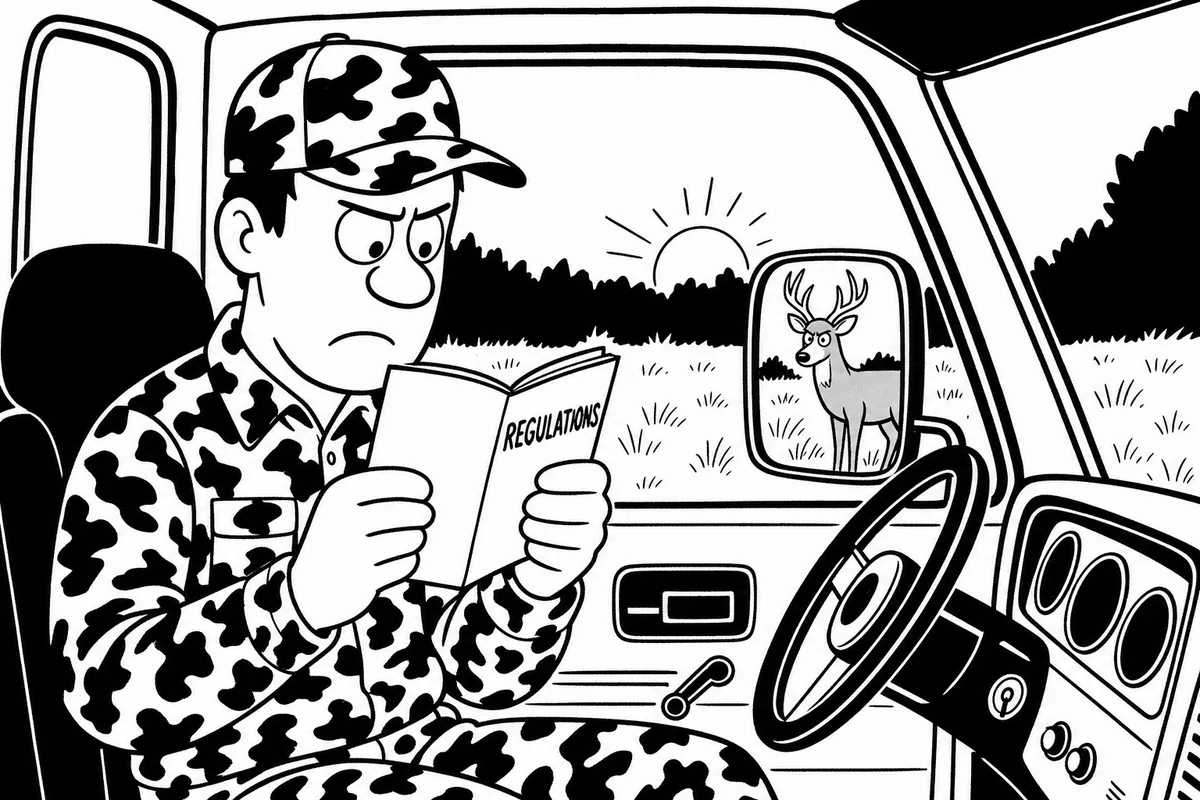
You have paid, over your lifetime, roughly four thousand dollars to have animals killed on your behalf by strangers you will never meet.
Buying it for somebody else? Find their field guide.
5 things this book knows
Quoted from Hunting & Fishing for City People exactly as printed. Every figure is the book’s own.
- Fish hooked: one, for approximately 1.5 seconds, a violence-free encounter the fish has probably not bothered to remember.
- Know 1-10-1: 1 minute to control breathing, 10 minutes of meaningful movement, 1 hour of consciousness.
- No raw or cured wild-caught fish without FDA-spec freezing (about −4°F for 7 days).
- Trap-check intervals are law, not advice — commonly every 24 hours, specified per state and per set type.
- Your opponent smells you at hundreds of yards, sees 300 degrees of motion, and reads blaze orange as gray.
The reference cards, free
Straight out of this volume’s own appendix, which opens by telling the reader to photocopy it freely and laminate it shamelessly.
THE “YOUR STATE” WORKBOOK PAGE
Everything in both halves of this book runs through your state wildlife agency. Fill this in tonight — pen, not intentions. A completed example follows the blanks.
MY STATE WILDLIFE AGENCY - Agency name: - Official website (verify it’s the .gov / official domain — third-party lookalike license sites upcharge): - License-purchase page bookmarked on phone: ☐ - Regulations booklet (current year) downloaded or picked up: ☐ Location of my copy: - Warden / poaching tip line (all states have one; save as a contact):
FISHING - Resident annual fishing license cost: $ License on my person while fishing (app or paper): ☐ - Trout/salmon or other special stamps needed for my waters: - The three waters I’ll actually fish, with their special regs (season, size, creel — check the water-by-water section): 1. regs: 2. regs: 3. regs: - My state’s fish consumption advisory page (search “[state] fish consumption advisory”): - Free Fishing Days (most states offer license-free intro days each year — the legal way to try before buying):
HUNTING - Hunter education course: provider date enrolled ☐ COMPLETED — card # - Resident hunting license cost: $ Deer tag/permit type for my unit (OTC or draw? application deadline!): - My management unit/zone number: - Season dates THIS YEAR — archery: muzzleloader: firearm: - Legal weapon rules for my unit (rifle / shotgun-slug / straight-wall / other): - Blaze orange requirement (square inches / garments): - Legal shooting hours definition: - Tag validation rule (notch at kill? electronic check-in window?): - Harvest reporting deadline and method: - Evidence-of-sex / carcass transport / CWD rules for my unit: - Tracking-dog services legal here? ☐ yes ☐ no — contact if yes: - Firearm transport law (vehicle rules):
TRAPPING (concepts only until every box below is done) - Trapping license exists separately: cost $ - Trapper education required? ☐ yes ☐ no — course date: - State trappers’ association + next workshop: - Mandatory trap-check interval in my state: - My mentor (a licensed human, not a channel):
FILLED-IN EXAMPLE (composite state, for format only — yours will differ): Agency: State Dept. of Natural Resources — dnr.state.xx.gov. Fishing license $27/yr, trout stamp $12. Hunter ed: $25 online + free field day, card #H-88341. Deer: Unit 14, OTC antlerless + draw buck (apply by July 15!). Firearm season Nov 15–30, shotgun-slug/straight-wall only, orange: 400 sq in incl. head cover. Hours: ½ hr before sunrise to ½ hr after sunset, printed table p. 41. Tag: notch month/day at kill before moving; e-check-in within 24 hrs. Trap check: 24 hrs land sets. Tip line: 1-800-XXX-XXXX, saved.
THE FOUR RULES CARD
Cut out. Wallet, gun case, blind wall. This card is never funny.
THE FOUR RULES OF FIREARM SAFETY
1. Treat every firearm as loaded. Always.
2. Never point the muzzle at anything you are not willing to destroy.
3. Keep your finger off the trigger, outside the guard, until your sights are on the target and you have decided to shoot.
4. Be sure of your target — and what is beyond it.
All four, all the time, by everyone present. Any one rule kept prevents a tragedy; that is why none may lapse. Storage when absent: locked, unloaded, ammunition separately secured.
FIELD DRESSING SEQUENCE CARD
Built to be read kneeling in a field with the book propped on your pack. Full teaching: Chapter Ten.
BEFORE THE KNIFE 1. Confirm the animal is expired (approach from behind/above; touch the open eye with a stick — no blink, no response). 2. TAG: validate at the kill site, before moving. Photograph tag + animal. 3. Gloves on. Own cuts covered. Kit out: knife, spare, cord, game bags, wipes, light.
THE SEQUENCE 4. Position: on its back, spine downhill, legs spread (cord to a sapling helps). 5. Opening cut: pinch up hide at base of sternum → starter slit → two fingers under the wall as a guard → knife edge up, shallow, ride your fingers down the midline to the pelvis. Never puncture the paunch. (Preserve evidence-of-sex per state rules.) 6. Ring the vent: core a deep circle around the anus (and vulva) until the tract pulls forward free. Optional: tie off with cord. 7. Roll guts out and downhill; release connective tissue with blade always visible, cutting away from the pile. 8. Cut the diaphragm free along the inner ribcage rim, both sides. 9. The reach: grasp windpipe + esophagus high in the chest, cut above your grip (blade angled AWAY from your reaching arm), pull the connected mass down, back, and out. Save heart/liver in a game bag if eating (do). 10. Roll carcass cavity-down, drain 1–2 min. Prop cavity open with a clean stick. Air moving = clock slowing.
THE TEMPERATURE CLOCK - Gut within the hour of the kill; sooner in warm weather. - Target: carcass toward 40°F as fast as the day allows. Above 40°F, bacteria double on the order of every 20–30 minutes. - Warm day (50s°F+): skin and quarter onto bagged ice in coolers the same day. Hanging in warm air is not aging — it is spoiling. - Gut contents touch nothing; if contact — trim generously. Trim wide around the wound channel. Wash knife and hands before they touch anything else. - Sick-looking animal or organs: STOP. Call the warden. Most states reissue the tag. - The drag-out is the day’s deadliest phase for hunters over 40 (cardiac). Help, rope or sled, rest breaks, phone on your person.
What each chapter comes down to
One line per chapter, in order — the book’s own summary of itself. The argument, the worked examples and the reasoning are in the volume.
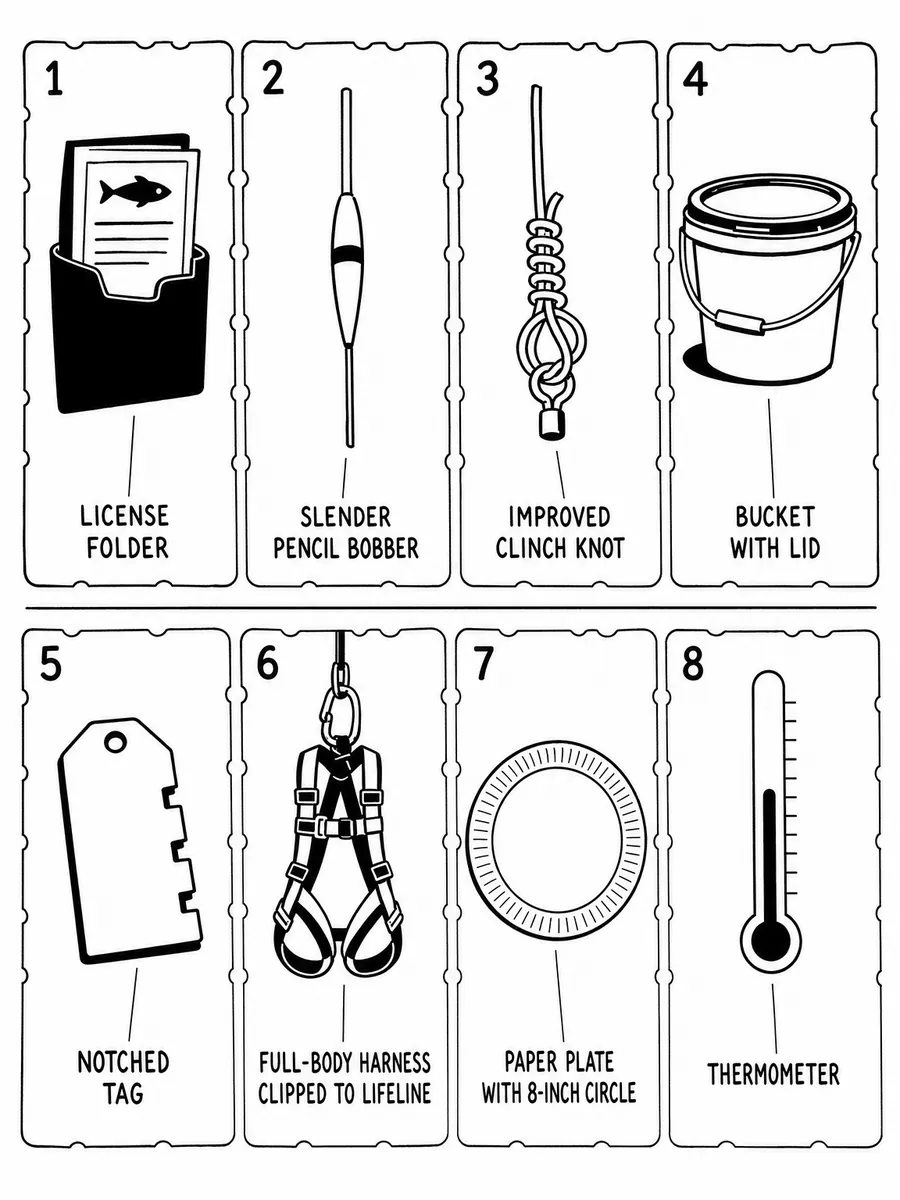
- Gear: The $80 Kit That Outfishes the $900 OneLicense first — it’s the only mandatory gear ($20–$40) and it funds the fish. Then $80 buys everything else that matters: a medium-light spinning combo, 8-lb mono, small long-shank hooks, split shot, a slender bobber, one card of jigs, pliers, clippers, a bucket, worms. The aisle is fishing for you. The worm is fishing for fish.
- Reading Water: The Fish Has a MortgageNinety percent of the fish hold in ten percent of the water — the edges: weed lines, docks, laydowns, drop-offs, and river seams where slow water meets the fast-water food conveyor. Fish face upstream; approach from behind; fish the edges of the day at the edges of the water, and scout five minutes with your eyes before one cast.
- Catching Fish, or: The Honest Failure RatesZero fish for the first two or three trips is normal — the skills compound and then cross a threshold, so pay the tuition. One rig (size 8 hook, one split shot, slender bobber, half a worm, 2–3 feet deep on an edge), one knot, a brisk lift of a hookset, tight line, wet hands, and the twenty-minute rule will catch your first hundred fish. And 1-10-1 is the cold-water law: one minute, ten minutes, one hour.
- The Fish Doesn’t Clean Itself: Kill, Clean, CookThe moment a fish becomes dinner, dispatch it at once — one decisive blow — bleed it, and get it on real ice; the cold chain is yours alone. Clean it with the off-hand behind the edge, cook it to 145°F or opaque-and-flaking, no raw experiments without FDA freezing, and waste nothing — the middle of the process is what makes the meal honest.
- Trapping: The Chapter That Is Mostly a Locked DoorTrapping is the oldest unattended machine in the food business, which is exactly why it’s the most regulated skill in this book: separate license, trapper education, dated seasons, mandatory check times (commonly 24 hours), tagged traps, and the Interstate Wildlife Violator Compact turning one state’s revocation into fifty. The path is license → course → association → mentor. Improvised snares are poaching with extra suffering; this book teaches none, ever.
- What Hunting Actually Is (90% Walking, 9% Sitting, 1% Event)Hunting is 90% walking, 9% sitting, 1% event — scouting and wind discipline are the sport, the shot is the paperwork. Your opponent smells you at hundreds of yards, sees 300 degrees of motion, and reads blaze orange as gray. Hunter education (state wildlife agency, free-to-$50, required nearly everywhere) is the non-negotiable first step, and the harness goes on before your boots leave the ground: falls, not firearms, are hunting’s #1 serious injury.
- The Four Rules (Scripture, No Jokes)Treat every firearm as loaded; never point the muzzle at anything you are not willing to destroy; finger off the trigger until sights are on target and the decision is made; know your target and what lies beyond it. The rules are redundant on purpose — all four must fail for tragedy — so all four are kept, always, by everyone, and storage (locked, unloaded, ammunition separate) is the fifth rule for every hour you’re not there.
- Calibers Without the Forum Brain-RotA cartridge is case, primer, powder, bullet — and the decision is three questions: legal in your state and unit (rifle, shotgun/slug, or straight-wall — the regs decide before ballistics do), adequate for the animal (every mainstream deer cartridge is), and shootable by you — because recoil builds flinches and flinches lose deer. Adequate-and-practiced beats magnum-and-flinchy, your hunter-ed instructor and local shop beat any forum, and the zero gets confirmed before every season.
- Shot Placement, Effective Range, and the Ethical KillOne target — the heart-lung plate, 8–10 inches, behind the shoulder, lower half of the chest. Two shots — broadside and quartering-away; everything else is a pass. One number — your effective range, tested to every-shot-in-the-plate from field positions, written down and obeyed. Then mark, wait 30–45 minutes (hours if in doubt), and track to the end: recovery is the law in most states and the promise in all of them.
- Field Dressing: The Temperature Clock Is RunningThe clock starts at the fall: tag first, gloves on, gutted within the hour — two fingers under an edge-up blade, ring the vent, free the diaphragm, one long pull — then drain, prop, and drive for 40°F, quartering onto ice on warm days. Nothing from the gut touches the meat, bloodshot tissue gets trimmed wide, wanton waste is a statute, and the freezer is the last measure of respect.
- THE SINCERITY: The First DeerTaking a life to feed people is the oldest serious promise there is — thank you, we needed it, nothing will be wasted — and every procedure in this book is that promise translated into labor. The weight you feel over the animal isn’t the flaw in the hunt. It’s the proof you’re keeping the terms.
Common questions
What are the four rules of firearm safety?
Treat every firearm as loaded, always. Never point the muzzle at anything you are not willing to destroy. Keep your finger off the trigger, outside the guard, until your sights are on the target and you have decided to shoot. Be sure of your target and what is beyond it. All four, all the time, by everyone present.
Where do I buy a hunting or fishing licence?
From your state wildlife agency's own website. Verify the official .gov or agency domain first — third-party lookalike licence sites are legal but upcharge. Download the current year's regulations booklet at the same time.
What is the first thing to do after a kill?
Confirm the animal has expired, approaching from behind and above. Then validate the tag at the kill site, before moving anything, and photograph the tag with the animal. Gloves on, own cuts covered, before the knife comes out.
What this book is not
It is a field guide, not a medical, legal or structural authority. Where a mistake maims or kills, the book stops joking and says so on the page; this site does the same. Nothing here replaces emergency services, a physician, a licensed tradesperson, or the law where you live.
This edition
| Series | For City People, volume 6 of 10 |
| Pages | 198, 6 × 9 in |
| Illustrations | 14, drawn for this book |
| Words | 35,370 |
| Paperback | 979-8-90623-265-6 |
This page is a reference, not an authority. It is field-guide material, not medical, legal, electrical or structural advice, and nothing on it replaces emergency services, a physician, a licensed tradesperson, or the law where you live.
No plant is edible on the say-so of a web page. In a real emergency the first instruction is to call for help. Local code outranks any page here.
Dr. Buck Savage is a fictional narrator and is not a doctor. The reference material is real and is drawn from the published books; the man is not.
Department of tactful suggestions / volume 06
Someone came to mind.
Send them a field guide. Let the cover do the explaining.