Volume 05 of 10 · For City People
First Aid
WebMD Says You’re Dying. For Once, Let’s Make Sure It’s Wrong.
What should a home first aid kit contain?
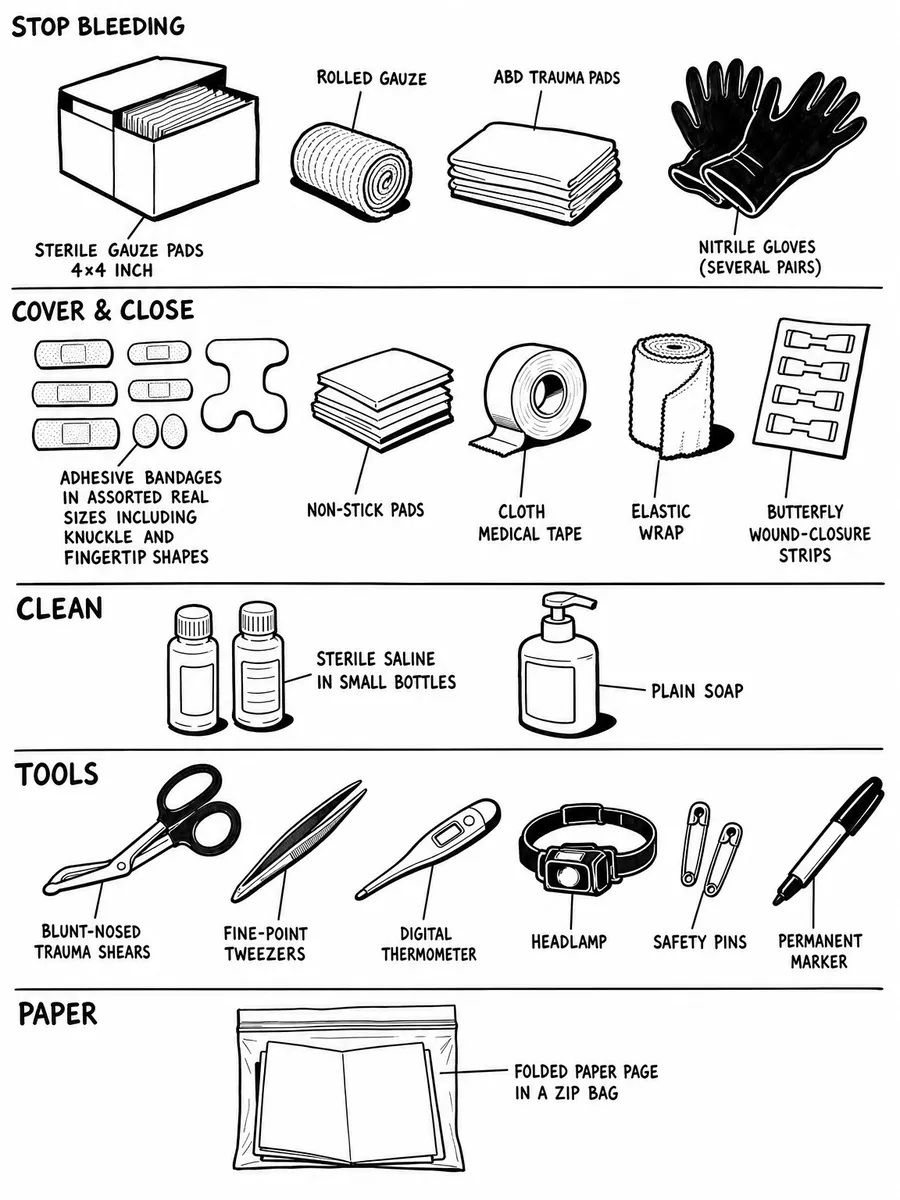
A pressure-and-clean core covers the great majority of household events: nitrile gloves, a full box of 4×4 sterile gauze pads, rolled gauze, properly assorted adhesive bandages, non-stick pads for burns, cloth tape and shears — about $25–40. The test that matters is not the contents. It is whether everyone in the house can find it in sixty seconds, in the dark.
From First Aid for City People by Dr. Buck Savage†. 216 pages · 24 illustrations.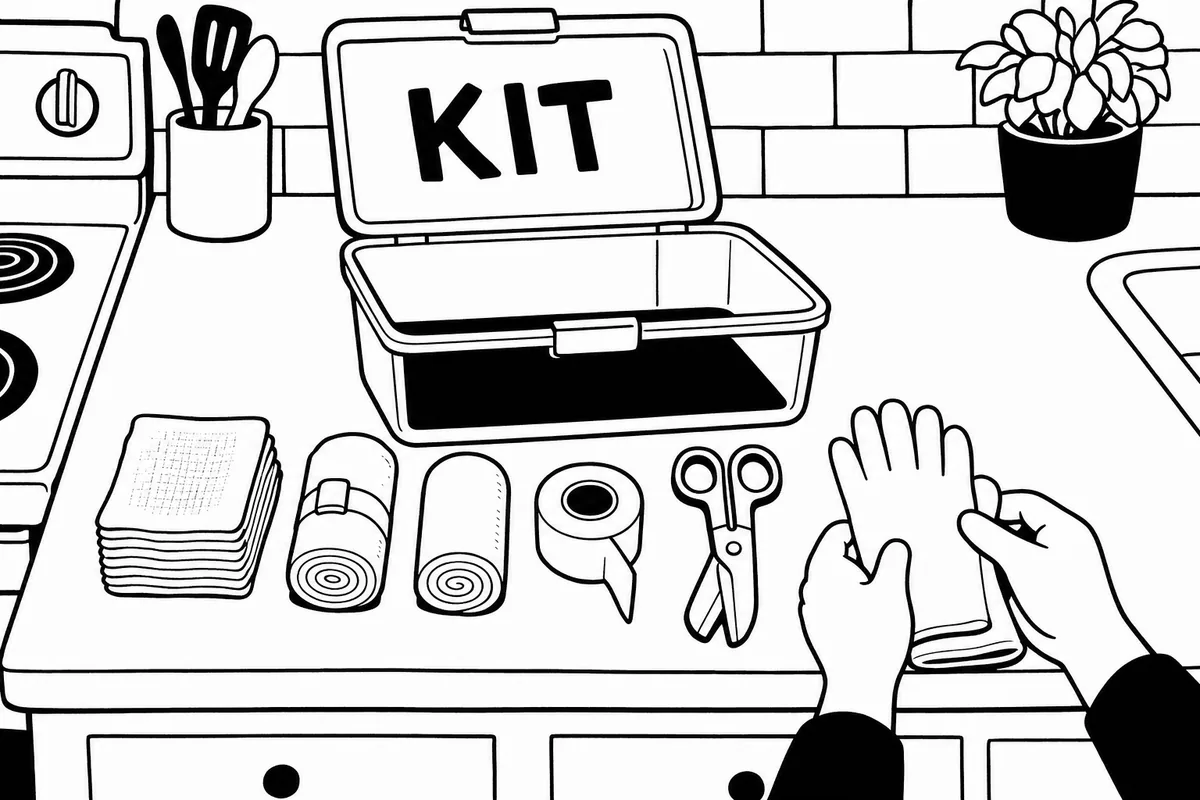
Your first aid kit is a decorative tin containing forty adhesive bandages and a mint.
Buying it for somebody else? Find their field guide.
4 things this book knows
Quoted from First Aid for City People exactly as printed. Every figure is the book’s own.
- Take Stop the Bleed (bleedingcontrol.org, ~90 minutes, often free) before adding a tourniquet or hemostatic products to your kit.
- Step two: cool running water, 10 to 20 minutes.
- Chemical burns: brush off dry chemicals first, then flush 20 minutes with running water; remove contaminated clothing; bring or photograph the container.
- Why the bystander is the whole story, one number: for every minute a person in cardiac arrest goes without CPR and defibrillation, the odds of survival fall by as much as 10 percent.
The reference cards, free
Straight out of this volume’s own appendix, which opens by telling the reader to photocopy it freely and laminate it shamelessly.
THE MED KIT, ITEMIZED — THREE BUDGET TIERS
Build the tier you’ll actually maintain, in a container you can grab one-handed. A clear plastic box or zippered pouch beats anything decorative. Label the outside: KIT, plus the date of last check. The sixty-second rule (Ch. 1) applies to every tier: findable in 60 seconds, in the dark, by everyone who lives with you.
TIER 1 — “THE SHOEBOX” (~$25–40)
The pressure-and-clean core. Covers the great majority of household events. - [ ] Nitrile gloves — 4+ pairs - [ ] Sterile gauze pads, 4×4” — full box (10+) - [ ] Rolled gauze — 2 rolls - [ ] Adhesive bandages, ASSORTED real sizes incl. knuckle + fingertip - [ ] Non-stick pads (for burns/abrasions) — 4+ - [ ] Cloth medical tape — 1 roll - [ ] Elastic wrap (2”–3”) — 1 - [ ] Antiseptic: sterile saline (small bottles/ampules) — not peroxide or alcohol for open wounds (Ch. 1) - [ ] Fine-point tweezers (metal, rigid) - [ ] Digital thermometer - [ ] Mylar emergency blanket - [ ] Permanent marker + safety pins - [ ] THE PAPER LAYER: copy of the YOUR PEOPLE page (Section 4), in a zip bag
TIER 2 — “THE REAL KIT” (~$60–100)
Everything in Tier 1, plus: - [ ] Trauma shears (blunt-nose) - [ ] ABD/trauma pads (5×9” or larger) — 2+ - [ ] Second elastic wrap (wider) + triangular bandage - [ ] Butterfly closures / wound-closure strips (with the Ch. 2 rule: strips are not a substitute for stitches decisions) - [ ] Burn dressings or a designated non-stick burn set + cling film note taped in lid (Ch. 3) - [ ] Instant cold packs — 2 (barrier rule, Ch. 4) - [ ] Headlamp (tested at each inspection) - [ ] Small bottle eye-wash saline - [ ] OTC med layer, all in original packaging, label doses only (Ch. 8): acetaminophen; ibuprofen; loratadine or cetirizine; diphenhydramine; oral rehydration salts ×3+; loperamide; antacid; hydrocortisone 1%; petrolatum - [ ] Duplicate mini-kit for the car (inspected more often — heat ages supplies; Ch. 1)
TIER 3 — “THE TRAINED KIT” (~$120–180)
Everything in Tiers 1–2, plus the items below. THIS TIER IS LOCKED UNTIL YOU TAKE STOP THE BLEED. Untrained, these are props (Ch. 1–2). Trained, they are the difference. - [ ] Commercial windlass tourniquet (buy from a reputable medical supplier — counterfeits are a documented problem; your course will name trusted models) - [ ] Compressed/rolled gauze for wound packing (hemostatic gauze optional, per your training) - [ ] Second tourniquet for the car kit - [ ] Pocket CPR barrier mask (after your CPR course) - [ ] Your certification cards, photocopied, in the lid
PLACEMENT + LIFECYCLE
-
Home kit: announced fixed location, cool + dry + dark — NOT the bathroom (Ch. 1, 8).
-
Car kit: cabin not trunk if climate allows; inspect every season.
-
Go-bag mini-kit: Tier 1 core in a pouch.
-
Inspection: twice a year, pegged to the clock changes. Open everything; replace expired/dried; test the headlamp; re-date the lid.
-
Restock rule: same week you use anything (Doreen, Ch. 1).
THE RED-FLAGS CARD
Print two: one inside the medicine-shelf door, one folded behind the kit’s paper layer. This is the Ch. 9 card. It is a recognition list, not a diagnosis list.
CALL 911 NOW — CALL, DON’T DRIVE. LOCATION FIRST.
-
Chest pressure/pain > a few minutes, or recurring — especially with sweating, nausea, shortness of breath, or spread to arm/jaw/neck/back. (Dispatcher may direct aspirin — follow the dispatcher.)
-
Stroke — BE-FAST: Balance loss / Eyes (sudden vision change) / Face droop / Arm drift / Speech trouble / Time = call now, note onset time. Symptoms that pass completely still get the call (TIA).
-
Anaphylaxis: symptoms in 2+ body systems after exposure, or any throat/tongue swelling or trouble breathing. Epinephrine FIRST if prescribed, 911 always after. Antihistamines are not treatment.
-
Labored breathing: can’t finish a sentence; blue-gray lips; visible effort.
-
Bleeding that spurts, pools, or soaks through continuous pressure; amputation (Ch. 2).
-
Head injury with: any loss of consciousness, repeated vomiting, worsening headache, confusion, seizure — and ANY head impact on blood thinners (same-day evaluation minimum).
-
Thunderclap headache: worst-ever, seconds to peak.
-
Abdomen: severe pain + rigid belly; vomiting blood / black tarry stool; severe pain in pregnancy; sudden testicular pain (hours count).
-
Seizure: first ever, > 5 minutes, repeating, or in water.
-
Sepsis pattern: infection + confusion, shaking chills, fast breathing, racing heart, or “sickest I’ve ever felt.” Say the word “sepsis.”
-
Heat stroke: hot + mental change — cool aggressively while EMS rolls (Ch. 7). Severe hypothermia: barely responsive + cold — gentle handling, insulate, call (Ch. 7).
-
Unresponsive + not breathing normally (gasps count as not breathing): 911 on speaker + hands-only CPR + send for AED (Ch. 6).
-
Suicidal crisis: 988 — call or text, free, 24/7. Attempt underway: 911.
URGENT CARE — TODAY, NOT TONIGHT’S KILLER
-
Cuts needing stitches (go the same day — closure window is hours; Ch. 2)
-
Possible fracture needing X-ray: failed four-steps test, bone tenderness, any child’s “sprain” (Ch. 4)
-
Burns above home-care line but below 911 line (Ch. 3)
-
Spreading/red/hot wound infections; UTI; ear; strep; tetanus boosters
-
Sprains not improving in 2–3 days
HOME + WATCH
- Minor wounds improving daily; simple sprains on the modern-RICE protocol; small cooled burns; ordinary colds and fevers responding per label guidance — with the standing appeal clause: worsening, or not improving on schedule, moves up a lane.
PHONE LIST — put these in your phone tonight: 911 · 988 (crisis) · Poison Control 1-800-222-1222 · your pharmacy · your doctor · nearest ER · nearest urgent care. Set up your phone’s lock-screen medical ID.
What each chapter comes down to
One line per chapter, in order — the book’s own summary of itself. The argument, the worked examples and the reasoning are in the volume.
- The Autopsy of a First Aid KitA kit is built by jobs — stop bleeding, cover, clean, tools, paper — findable in sixty seconds in the dark, restocked the week it’s used, and grown no faster than your training. Anything else is a costume with a cross on the lid.
- Bleeding: The Red ChapterPressure, right on the wound, add-don’t-remove, ten minutes by a clock, no peeking — that’s the treatment, not the prelude to it. Spurting, pooling, or soaking through means 911 now, because for the first minutes the bystander IS the response. And a tourniquet is ninety minutes of training away — take Stop the Bleed and stop being a spectator to the worst five minutes.
- Burns: The Folklore AutopsyCool running water, 10 to 20 minutes by the clock, is the treatment — never ice, never anything from the pantry. Jewelry off, cover loose and non-stick, blisters stay sealed, and the palm is 1%: bigger than a palm, full-thickness, face-hands-feet-joints, electrical, chemical, smoke, the very young or old — professionals, now.
- Sprains, Breaks, and the Ankle That LiedDeformity, open skin, or a pale-cold-numb limb is an emergency now. Can’t take four steps, bone tenderness, a pop, or any child’s “sprain” — get the picture the same day; a negative X-ray is the product, not a waste. For true sprains: protect briefly, move early and gently, ice about 20 minutes at a time for pain with a barrier, compress snug not throbbing, elevate — and give it weeks, not the weekend.
- Choking: The Quietest EmergencyReal choking is silent — the cougher is winning, so encourage the cough and touch nothing; the silent one, hands at throat, maybe walking away, is the emergency: ask “are you choking?”, delegate 911 by name, and let trained hands work. The trained response — five-and-five, per the Red Cross — lives in a course, the course is one afternoon, and the brain’s clock is four minutes: shorter than any ambulance.
- CPR: The Class You’re Going to TakeUnresponsive plus not-breathing-normally — and gasps count as not breathing — means call 911 on speaker, push hard and fast in the center of the chest, two inches, 100–120 a minute, full recoil, minimal pauses, and send someone for the AED, which you cannot use wrong by turning on. Hands-only is the floor that exists so nobody stands and watches; the full half-day course — children, infants, drowning, breaths — is the standard. Survival falls as much as ten percent a minute. Take the class.
- Too Cold, Too Hot: The Body’s Narrow CountryWet plus wind is the real cold math — water steals heat ~25 times faster than air — and the umbles are the thermometer; shivering that stops is a siren, and the severely cold get handled like glass, insulated at the trunk, and left to professionals. On the heat ladder, sweat and misery mean exhaustion — shade, cool, sips, thirty-minute clock — but a changed mind means heat stroke: 911 and aggressive cooling with everything wet and cold you own. In both directions, the victim doesn’t get a vote. Read the rungs for them.
- The Medicine Cabinet: An ArchaeologyThe drugstore is six hundred products wearing a dozen molecules in trench coats — learn generic names, stock single-ingredient products by job, and never exceed a label ceiling summed across ALL sources, especially acetaminophen. No aspirin for children, ever. Label doses only, original containers, cool dark storage, twice-yearly sweep — and the pharmacist answers interaction questions for free. Ask.
- The Bright Line: Go. I Am Begging You.You are never required to diagnose — only to recognize the alarms and outsource fast: chest pressure with company, any BE-FAST sign even if it passes, anaphylaxis (epi first), labored breathing, head injury on blood thinners, thunderclap headache, rigid belly, first seizures, the sepsis pattern — 911, call-don’t-drive, location first. Urgent care is for today-problems, not tonight-killers. Wrong costs a copay; waiting can cost everything — and nobody competent has ever said “I wish they’d waited longer.”
- THE SINCERITY: The Person the Room Turns ToThe room always elects someone, and the elected are just the ones who decided in advance — a folding chair, a Saturday, a plastic torso — to be worth the turning heads. First aid is the one skill you learn almost entirely for other people, which means the class is a love letter you write years early to whoever ends up on the floor. Write it. She did. It’s why I’m here.
Common questions
When should I call 911 rather than drive to hospital?
Call, don't drive, and give your location first. Chest pressure lasting more than a few minutes — especially with sweating, nausea, breathlessness, or pain spreading to arm, jaw, neck or back. Any BE-FAST stroke sign. Anaphylaxis. Symptoms that pass completely still get the call.
What is BE-FAST?
The stroke recognition list: Balance loss, Eyes (sudden vision change), Face droop, Arm drift, Speech trouble, Time — call now and note the onset time. It is a recognition list, not a diagnosis list.
Where should a first aid kit be kept?
Somewhere every member of the household can reach it one-handed within sixty seconds without a light on. A clear plastic box or zip pouch beats anything decorative. Label the outside with the word KIT and the date it was last checked.
What this book is not
It is a field guide, not a medical, legal or structural authority. Where a mistake maims or kills, the book stops joking and says so on the page; this site does the same. Nothing here replaces emergency services, a physician, a licensed tradesperson, or the law where you live.
This edition
| Series | For City People, volume 5 of 10 |
| Pages | 216, 6 × 9 in |
| Illustrations | 24, drawn for this book |
| Words | 34,802 |
| Paperback | 979-8-90623-263-2 |
This page is a reference, not an authority. It is field-guide material, not medical, legal, electrical or structural advice, and nothing on it replaces emergency services, a physician, a licensed tradesperson, or the law where you live.
No plant is edible on the say-so of a web page. In a real emergency the first instruction is to call for help. Local code outranks any page here.
Dr. Buck Savage is a fictional narrator and is not a doctor. The reference material is real and is drawn from the published books; the man is not.
Department of tactful suggestions / volume 05
Someone came to mind.
Send them a field guide. Let the cover do the explaining.