Volume 04 of 10 · For City People
Fire & Power
Prometheus Didn’t Die for This
What should you do first in a power outage?
Light, scope, report, protect, seal. Headlamp before flame. Check your breaker panel, then the window — your breakers tripped while the hallway has power is your problem; dark neighbours is an area outage. Report it while the towers are still up, unplug electronics against the restoration surge, and shut the fridge.
From Fire & Power for City People by Dr. Buck Savage†. 194 pages · 13 illustrations.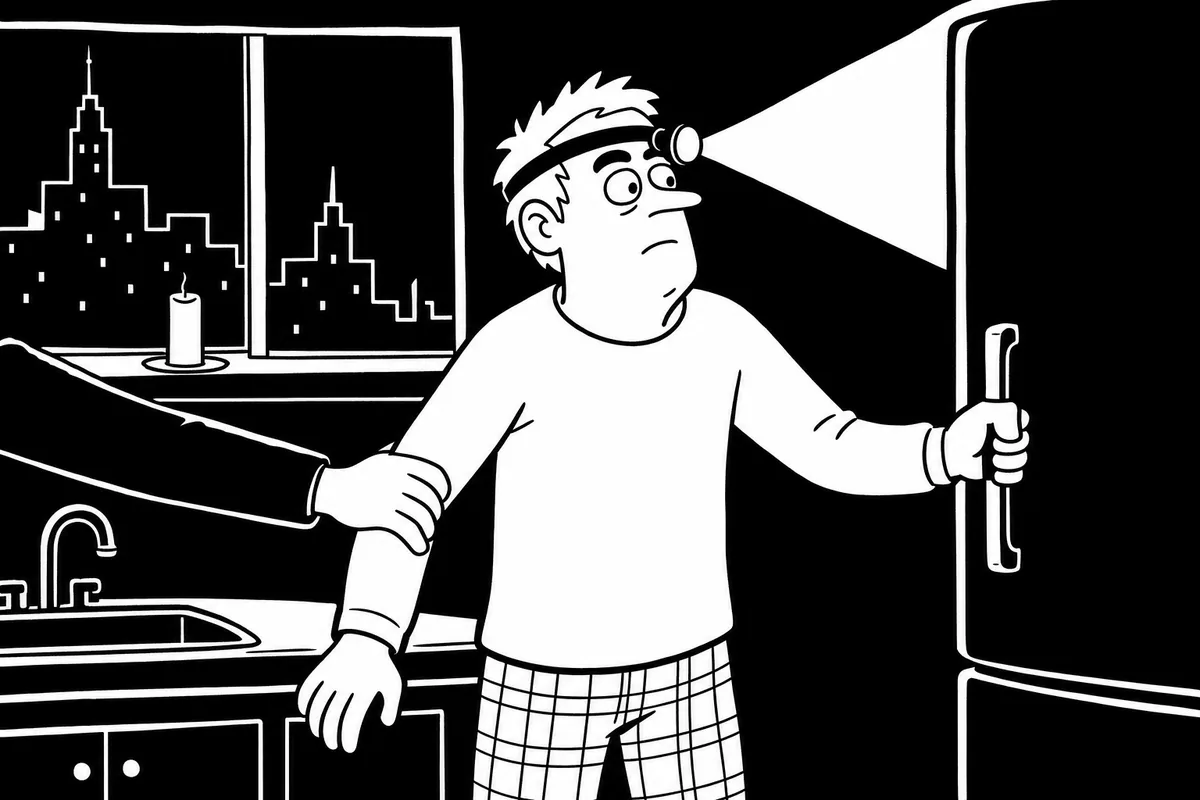
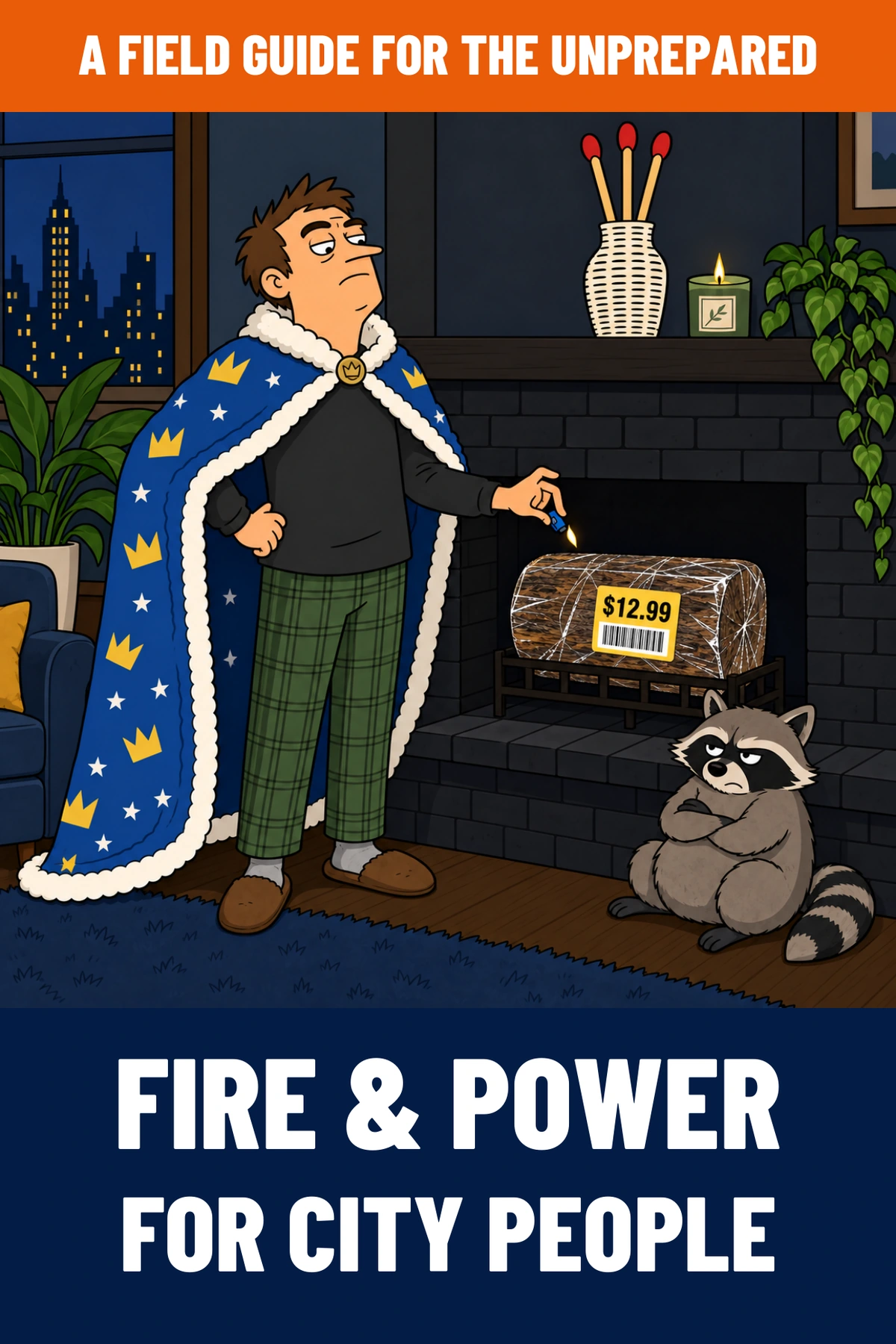
You own three ornamental matches in a designer vase and a candle that smells like a library.
Buying it for somebody else? Find their field guide.
5 things this book knows
Quoted from Fire & Power for City People exactly as printed. Every figure is the book’s own.
- Slow heavy strokes, pull the rod not the striker, and feed sparks only the finest tinder (petroleum-jelly cotton balls burn 4–5 minutes).
- Not by an open window “for the cord.” At least 20 feet, exhaust away from openings.
- Test monthly; replace batteries on the chirp; replace units by the date printed on the back (typically 5–10 years).
- In an open room, those 100 watts drift up to warm the ceiling for nobody.
- The arithmetic first, so the temptation dies of math: a candle’s flame delivers on the order of 80 watts of heat.
The reference cards, free
Straight out of this volume’s own appendix, which opens by telling the reader to photocopy it freely and laminate it shamelessly.
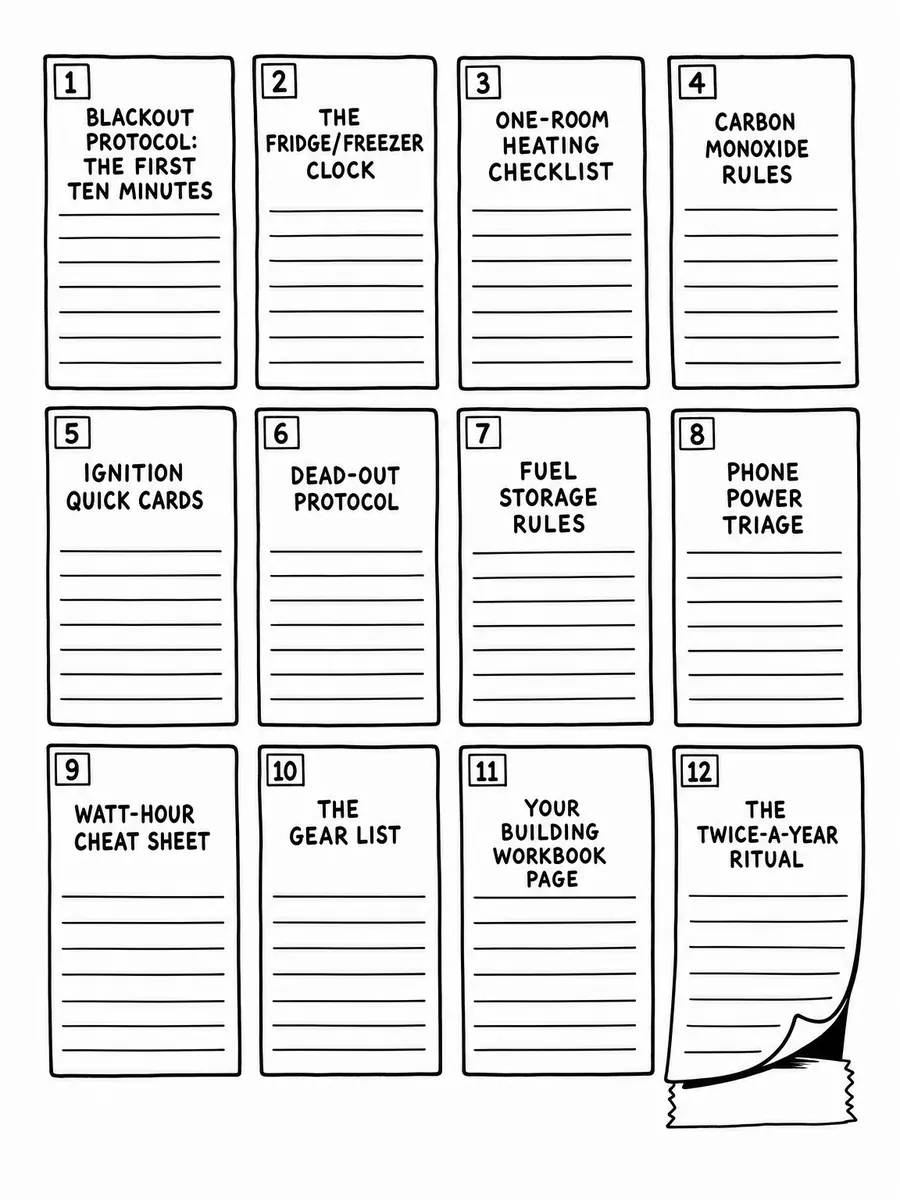
CARD 1 — BLACKOUT PROTOCOL: THE FIRST TEN MINUTES
(wallet card / inside a kitchen cabinet door)
-
LIGHT — headlamp/flashlight first. Flame is last resort.
-
SCOPE — breaker panel, then window. You / building / block?
-
Your breakers tripped + hallway has power = your problem (reset once; twice = investigate).
-
Neighbors dark = area outage.
-
REPORT — utility outage line/app now, while towers are up:
-
PROTECT — unplug computers/TV/electronics (restoration surges). Leave ONE lamp switched on as the power-return signal.
-
SEAL — fridge/freezer are now vaults. Say it out loud to the household.
-
WATER — on a well, boost pump, or rooftop tank? Draw pots/bottles NOW while pressure holds.
-
CLIMATE — winter: one-room plan (Card 3) within the hour. Summer: shades down, lowest floor, hydrate.
-
PEOPLE — knock: elderly / disabled / powered-medical / alone. Do it in the first hour.
-
PHONE TRIAGE — Card 8. Low power mode at minute one, not at 20%.
-
SIT DOWN — light, report, food, water, heat, people: handled. Boredom is the remaining emergency. Cards are in the kit.
SUMMER HEAT VARIANT (steps 7–8 replace with): shades/blinds down on all sun-side glass by morning; move living to the lowest, shadiest room; water by schedule, not thirst; wet cloth on neck/wrists; no strenuous work in peak hours; battery fans if you have them. Heat emergencies escalate faster than cold ones — cramps → exhaustion (heavy sweat, weakness, nausea) → heat stroke (hot dry or confused person = 911, cool them immediately). Cooling centers are listed on your municipal site; the elderly-neighbor knock matters MORE in heat than in cold.
LIGHT SOURCES, RANKED (buy in this order)
-
Headlamp — hands-free; the blackout is a two-handed event. 20–50 lumens is comfortable; runtime-at-low beats max-brightness on every spec sheet.
-
Lantern — one shared glow for the room beats forty beams.
-
Flashlight — fine; lives by the bed and in the kitchen.
-
Candles — LAST. Light, never heat. 12” clearance, hard surface, real holder (stored WITH the candles), below head height, never unattended, out before sleep.
CARD 2 — THE FRIDGE/FREEZER CLOCK (USDA)
(tape inside the refrigerator door)
UNOPENED, food stays safe: - Refrigerator: ~4 HOURS - Freezer, FULL: ~48 HOURS - Freezer, HALF-FULL: ~24 HOURS
The line is 40°F. The window is 2 hours. - Perishables (meat, poultry, seafood, dairy, eggs, leftovers, cut produce) above 40°F for more than 2 hours = DISCARD. - Never taste to test. Smell and appearance do not reliably reveal foodborne bacteria. - Refreeze only if: ice crystals still present, OR thermometer reads ≤ 40°F. - When in doubt, throw it out.
Prep (do today): appliance thermometer in fridge + freezer. Freeze water jugs in every freezer gap (thermal mass + ice + drinking water). Know your eat-order: fridge → freezer → pantry.
CARD 3 — ONE-ROOM HEATING CHECKLIST
(hall closet, with the window kit)
Pick the room: smallest usable / fewest windows / interior or neighbor-sharing walls / south glass a bonus. 1. ☐ Close EVERY other door in the home. 2. ☐ Windows: film or bubble-wrap the glass; heavy blankets/quilts over them at night, open to direct sun by day. 3. ☐ Dam the door gap: rolled towel / draft snake. Check sills for drafts. 4. ☐ Insulate the floor: rugs, pads, blankets — as much UNDER sleepers as over. 5. ☐ Build the fort: blankets over table/chairs/bed frame — low, vented, capturing body heat (a resting adult ≈ 100 W). Nothing that burns goes in or near it. 6. ☐ Layer people: loose layers, hat, dry socks; wool/synthetic over cotton. 7. ☐ Hot water bottles into bedding 20 minutes before people. 8. ☐ Flame rules (no exceptions): candles = light, not heat (~80 W each). 12” from anything combustible, sturdy holder, never unattended, OUT before sleep. Battery light preferred wherever people sleep. 9. ☐ Space heater (grid up): 3 ft clearance all around / hard level floor / wall outlet ONLY — never extension cord or power strip / tip-over + overheat shutoffs / OFF when sleeping or leaving. 10. ☐ NO fuel-burning heat indoors. Ever. (Card 4 overrides everything on this card.) 11. ☐ Leaving threshold: can’t keep the room safe for infants, elderly, or the ill → warming center / powered friend / shelter. Going is a skill.
Fall prep: window film installed by Thanksgiving; kit stocked (film, tape, cutter, tacks, draft snake); this card checked.
CARD 4 — CARBON MONOXIDE RULES
(this card is not funny. Post it where the household will see it.)
CO is colorless, odorless, and tasteless. You have no sense that detects it. It is produced by anything that burns.
NEVER: - Never burn charcoal indoors — any amount, any room, any container, any reason. - Never run camp stoves, fuel heaters, or fuel lanterns indoors unless that exact model is manufacturer-rated for indoor use and operated per its manual. Tents, garages, and porches count as indoors. - Never heat a home with a gas oven or range. - Never run any engine (generator, car, anything) in a garage, basement, or enclosed/attached space — even with the door open. - Generators: OUTSIDE ONLY, 20+ feet from the building, exhaust pointed away from all windows, doors, and vents.
ALARMS: - UL 2034 CO alarms on every level and outside every sleeping area (inside bedrooms is better) — with battery backup. - Test monthly. Replace batteries at the chirp. Replace the unit by the date on its back (typically 5–10 years).
SYMPTOMS: headache, dizziness, weakness, nausea, fatigue, confusion — “the flu without the fever.” Multiple people, same room, same hours = CO until proven otherwise.
IF THE ALARM SOUNDS: Everyone OUT to fresh air → head count → 911 from outside → no one re-enters until the fire department clears it. Symptoms? Say the words “carbon monoxide” to dispatch and medics. Non-emergency questions: Poison Control 1-800-222-1222 (24/7).
What each chapter comes down to
One line per chapter, in order — the book’s own summary of itself. The argument, the worked examples and the reasoning are in the volume.
- Fire Is a Supply ChainFire is a supply chain, not an event — a ladder of sizes where each rung must fully burn before the next is promoted. Ignition is 5% of the job; gathering and sorting tinder, kindling, and fuel BEFORE you strike is the other 95%. One match buys ten seconds: real tinder catches in three.
- Ignition: Five Ways, With the Failure Rates Nobody PrintsCarry two lighters and learn the ferro rod anyway — the lighter is the best tool and the rod is the one still working when every lighter is dead. Slow heavy strokes, pull the rod not the striker, and feed sparks only the finest tinder (petroleum-jelly cotton balls burn 4–5 minutes). Try friction once to learn reverence. And store steel wool away from batteries — the fifth method works whether you meant it or not.
- The Legal FireA legal fire is a defined thing — small, in a ring, 10 to 25 feet from anything that burns, under open sky, attended every minute, with water standing by. One call to your fire department’s non-emergency line gets your local rules; one 30-second check of burn bans and Red Flag Warnings clears every fire, every time. And a fire isn’t out until it’s drowned, stirred, drowned again, and COLD to the back of your hand — ashes hold live coals for days and go outside in metal, for a week.
- The Gas That Isn’t ThereCarbon monoxide is the gas that isn’t there — no color, no smell, no warning, produced by anything that burns, and it kills by suffocating you in a room full of air while disabling the brain you’d use to escape. Nothing that burns fuel runs indoors unless rated and vented for it; charcoal never, ovens are not furnaces, engines and generators outside only, 20+ feet, exhaust pointed away. And a UL-listed CO alarm with battery backup on every level and outside every sleeping area is not optional equipment. It is the only sense you have for this.
- Heat One Room, Not the HomeDon’t heat the home — hold one small room: fewest windows, doors shut on everything else, windows quilted and filmed, drafts dammed, bedding insulated underneath. You are a 100-watt heater; a blanket fort captures what an open room wastes. A candle is 80 watts of fire risk, not a heat source — and space heaters get three feet of clearance, a wall outlet only, and get turned off when you sleep.
- Your Walk-Up Is Flammable (and the Cord Under the Rug Knows It)Your wiring is a system with a voice — tripping breakers, warm outlets, and burning smells are reports, not nuisances. Cords are temporary, visible, and rated (lower gauge = thicker); nothing lives under a rug, and heaters plug into walls only. Smoke alarms expire at ten years and go in every bedroom, outside sleeping areas, every level. And from alarm to unlivable can be two minutes — so the plan (two exits, one meeting point) gets made tonight, not then.
- Blackout Protocol: The First Ten MinutesA blackout’s first ten minutes are a checklist, not an experience: safe light, diagnose (you/building/block), report it, unplug electronics and leave one sentinel light on, seal the fridge, draw water if yours rides on power, set the climate plan, knock on the vulnerable neighbor’s door, start phone triage, sit down. Then trust the USDA clock: fridge 4 hours, full freezer 48, half-full 24, the line is 40°F — and when in doubt, throw it out.
- Watt-Hours for the InnocentThe watt-hour is the only unit — battery bucket ÷ device drain = hours, and everything from power banks (a “10,000 mAh” bank is ~37 Wh: two to three phone charges, not four) to fridges (1–1.5 kWh a day) obeys it. Buy LiFePO4, store charged, top up quarterly — a battery stored dead dies for good. And a triaged phone (low power, screen dark, airplane when searching, one phone on duty, text don’t call) runs for days on the charge that reflex spends by midnight.
- Fuel: The Part of the Book Written in a Fireproof VoiceGasoline is a vapor hazard — heavier than air, always escaping, hunting pilot lights along the floor — so it lives ONLY in rated cans, small quantities, dated and rotated, in detached storage, never anywhere humans sleep, and in an apartment the correct amount is zero. Propane lives outdoors, all sizes, always. And the gentle fuels — dry wood off the floor, charcoal for outdoors, matches dry and high — turn the audit ritual you now own twice a year.
- THE SINCERITY: The Keeper of the FlameKneel next to them. Don’t take the thing — show, and wait, and let them light it. The skills were never yours; they’re the chain passing through you, and tending a fire for someone while they sleep is the oldest way our species has ever said what it means. Say it.
Common questions
Is it safe to heat a house with a gas oven or a charcoal grill?
No — never, in any amount, any room, any container, for any reason. Carbon monoxide is colourless, odourless and tasteless, and you have no sense that detects it. Never heat a home with a gas oven or range, and run generators outdoors only, at least 20 feet from the building.
What light should I buy for a blackout?
A headlamp first — a blackout is a two-handed event, and 20–50 lumens is comfortable. Then a lantern, because one shared glow beats forty beams. Then a flashlight. Candles last: light, never heat, and never unattended.
How long will my freezer keep food frozen without power?
About 48 hours if it is full and stays shut, about 24 hours if half full. Freeze water jugs into every gap in advance — they add thermal mass and become drinking water as they thaw.
What this book is not
It is a field guide, not a medical, legal or structural authority. Where a mistake maims or kills, the book stops joking and says so on the page; this site does the same. Nothing here replaces emergency services, a physician, a licensed tradesperson, or the law where you live.
This edition
| Series | For City People, volume 4 of 10 |
| Pages | 194, 6 × 9 in |
| Illustrations | 13, drawn for this book |
| Words | 33,650 |
| Paperback | 979-8-90623-261-8 |
This page is a reference, not an authority. It is field-guide material, not medical, legal, electrical or structural advice, and nothing on it replaces emergency services, a physician, a licensed tradesperson, or the law where you live.
No plant is edible on the say-so of a web page. In a real emergency the first instruction is to call for help. Local code outranks any page here.
Dr. Buck Savage is a fictional narrator and is not a doctor. The reference material is real and is drawn from the published books; the man is not.
Department of tactful suggestions / volume 04
Someone came to mind.
Send them a field guide. Let the cover do the explaining.