Volume 03 of 10 · For City People
Food Storage
Your Pantry Is a Museum of Sauces and You Will Die
What should a two-week emergency food supply contain?
About 28,000 calories per person — 2,000 a day for fourteen days. A baseline larder of rice, dried beans or lentils, oats, pasta, cooking oil, peanut butter and canned fish comes to roughly 30,000 calories, weighs 20–25 lb, and costs $40–60 at a discount grocery. Cooking oil is the calorie king at about 4,000 per pound.
From Food Storage for City People by Dr. Buck Savage†. 186 pages · 14 illustrations.
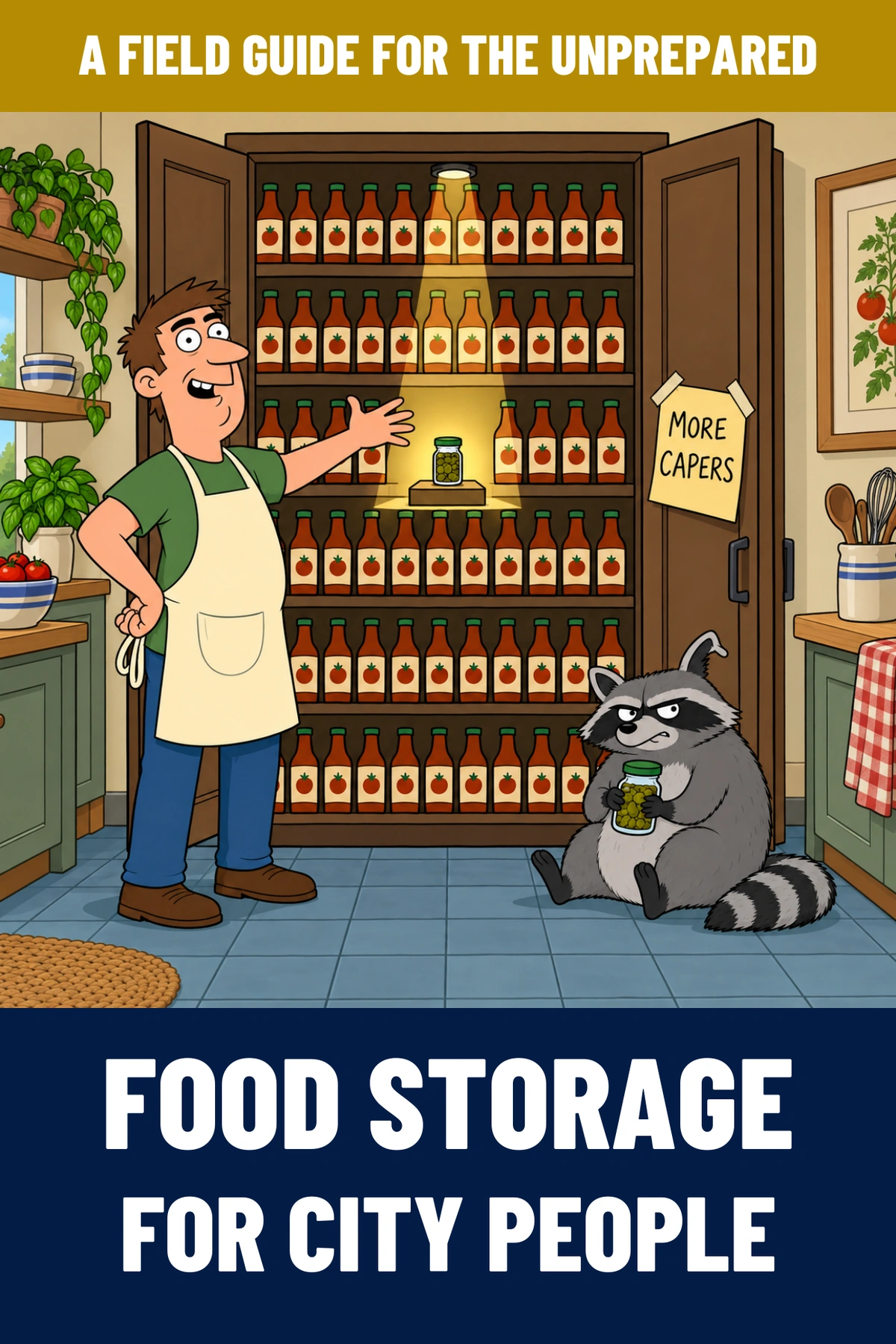
Open your pantry. Count the things that are food.
Buying it for somebody else? Find their field guide.
5 things this book knows
Quoted from Food Storage for City People exactly as printed. Every figure is the book’s own.
- Rice (white): about 1,650 calories per pound, dry.
- A five-pound bag is about 8,250 calories — four days of a person in one sack.
- Dried beans and lentils: about 1,600 calories per pound, dry — and this is where the protein lives.
- Three pounds of beans is about 4,800 calories and a wall of protein.
- Cooking oil: about 4,000 calories per pound — the single densest storable calorie you can buy.
The reference cards, free
Straight out of this volume’s own appendix, which opens by telling the reader to photocopy it freely and laminate it shamelessly.
THE TWO-WEEK BASELINE LARDER — SHOPPING LIST WITH CALORIES
One person, two weeks. Target: ~28,000 calories (2,000/day). This list totals ~30,000 for margin, weighs ~20–25 lb, and costs roughly $40–60 at a discount grocery. Scale by the number of people; adjust for your body, tastes, and medical reality.
| Item | Amount | Approx. calories |
|---|---|---|
| White rice (stores for years; NOT brown) | 5 lb | ~8,250 |
| Dried beans / lentils (protein; lentils need no soak) | 3 lb | ~4,800 |
| Rolled oats | 3 lb | ~5,100 |
| Pasta | 2 lb | ~3,340 |
| Cooking oil (calorie KING, ~4,000/lb) | 1 liter | ~8,000 |
| Peanut butter (no-cook fat + protein) | 16 oz jar | ~2,600 |
| Sugar or honey (honey never spoils; NOT for infants) | 1 lb / 1 jar | ~1,750 |
| Canned fish/meat (protein, eat cold) | 6 cans | ~1,200 |
| Canned tomatoes + vegetables (nutrition) | 4–5 cans | ~500 |
| Salt (function + morale + preservation) | 1+ lb | 0 |
| Multivitamins (closes vitamin gaps — highest value per ounce) | 1 bottle | 0 |
| Spices / hot sauce / coffee or tea (morale is a nutrient) | to taste | ~0 |
| TOTAL | ~20–25 lb | ~30,000 cal = ~15 days |
Rice + beans together = near-complete protein. Add fat (oil), salt, and a multivitamin and this list keeps you not just alive but functional. Store airtight, cool, dark; freeze new flour/grains a few days to kill pantry-moth eggs; bay leaves in the grain bins.
THE FIFO PROTOCOL CARD (run your pantry like a nightclub)
-
You are the bouncer. Stocking and un-stocking is a job you do, not a thing that happens.
-
Oldest to the front rope; newest to the back. Load new groceries BEHIND the old ones. Serve from the front. First In, First Out.
-
One out, one in. Use a can, replace a can. The store stays two weeks deep and always flowing.
-
Date everything the day it enters — your own big date on the lid/bag, not the tiny factory code.
-
Keep the guest list. An index card taped inside the door: what you own, when it dates. Pencil on a string. It doesn’t crash and needs no password.
-
“Best by” is a quality rumor — canned/dry goods last for years past it if the container is sound. “Use by” on perishables leans safety. The real discard signals are physical, below.
DANGER-ZONE TEMPS CARD (the joke-off numbers)
-
DANGER ZONE: 40–140°F. Bacteria multiply fastest here. Keep cold food ≤40°F, hot food ≥140°F.
-
Fridge ≤40°F. Freezer ≤0°F. MEASURE with a cheap thermometer — the dial that says “1–5” tells you nothing.
-
Two-hour rule: perishables out of refrigeration for 2 hours total = discard. 1 hour if above 90°F.
-
Power out (doors SHUT): fridge ~4 hours · full freezer ~48 hours · half-full ~24 hours. Freeze water jugs in advance to extend cold + yield drinking water.
-
Refreeze ONLY food that still has ice crystals or stayed ≤40°F. Fully thawed & warm: cook now (if cold) or throw out.
-
Thaw safely: fridge · sealed cold water (change every 30 min) · microwave-then-cook. NEVER the counter.
-
Cook to internal temp, not color: poultry 165°F · ground meat 160°F · whole cuts 145°F + rest · fish 145°F · reheated leftovers 165°F.
-
When in doubt, throw it out. The failure is invisible; your senses are not a safety test.
WHICH PRESERVATION METHOD? (a chooser)
-
High-acid food (fruit, jam, pickles, acidified tomatoes), want it shelf-stable a year? → Water-bath can (Ch. 5), tested recipe.
-
Low-acid food (vegetables, meat, fish, soup), want it shelf-stable? → Pressure can (Ch. 6), tested recipe, real canner — or don’t can it; freeze/dry instead.
-
Produce you’ll lose to the crisper drawer? Want it light and cordless? → Dehydrate (Ch. 7).
-
Best flavor, have freezer space and trust the grid? → Freeze (blanch veg first; tray-freeze then bag; but it’s cord-dependent — Ch. 8/9).
-
Roots, onions, squash, apples? → No processing — cellar them (Ch. 8): the two climates.
-
No tested recipe exists for it? → Do not can it. Dry it, freeze it, cellar it, or eat it fresh. “No tested recipe” is a complete answer.
-
Zero-effort, zero-risk entry point? → Refrigerator pickles (high-acid brine, fridge, weeks). The safest preservation there is.
THE ACID LINE CARD (which canning method — this decides safety, not style)
pH 4.6 is the line.
-
AT or BELOW 4.6 = HIGH-ACID = WATER-BATH safe: most fruit, jams/jellies, vinegared pickles, acidified tomatoes (must add bottled lemon juice or citric acid). Acid keeps botulism spores asleep; boiling water (212°F) handles the rest.
-
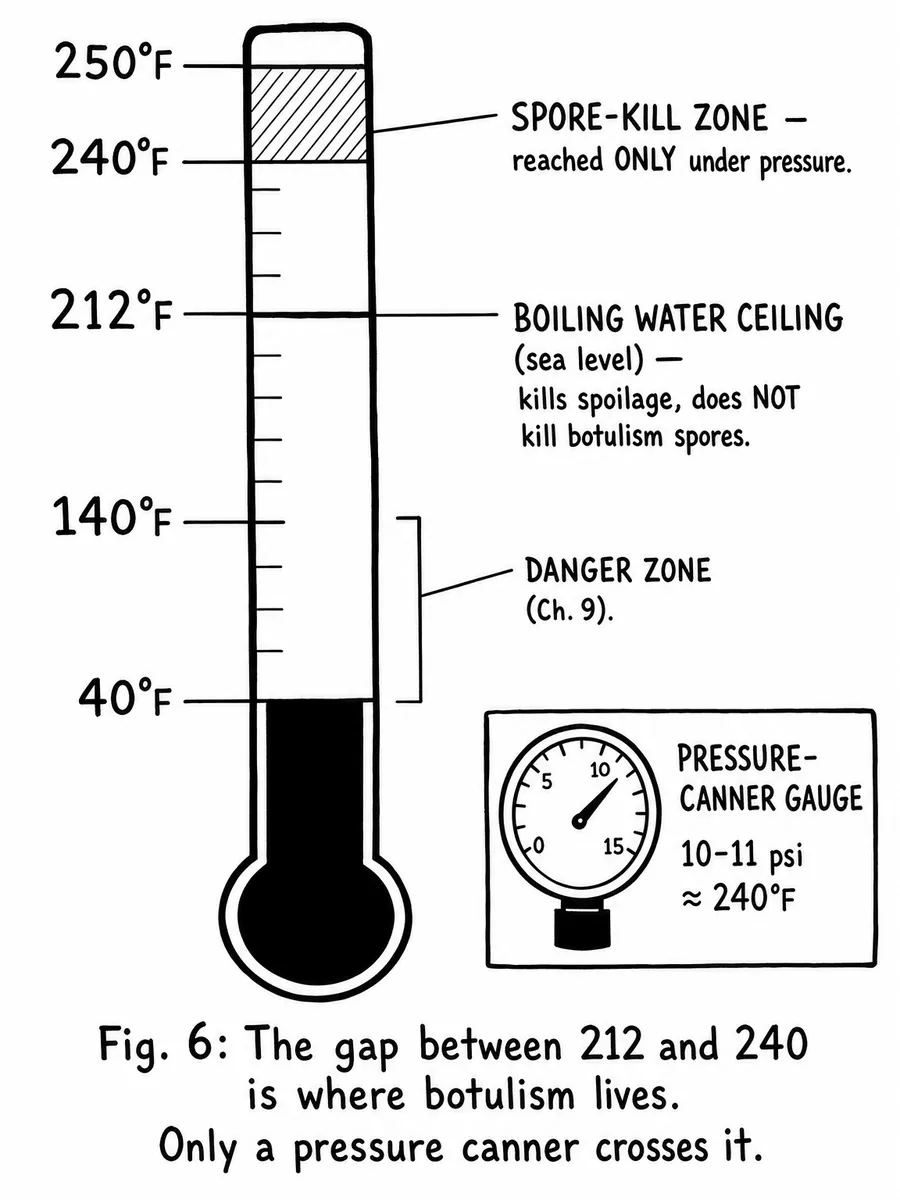
ABOVE 4.6 = LOW-ACID = PRESSURE CANNER ONLY: all plain vegetables, meat, poultry, fish, soups, mixtures. Boiling water does NOT kill the spores — only 240–250°F under pressure does.
-
TESTED RECIPES ONLY, always: National Center for Home Food Preservation (NCHFP) · USDA Complete Guide to Home Canning · your state Cooperative Extension Service · Ball / So Easy to Preserve. Flavor is yours to change; ratios, times, pressures, and headspace are not.
What each chapter comes down to
One line per chapter, in order — the book’s own summary of itself. The argument, the worked examples and the reasoning are in the volume.
- Calories vs. VibesYour body eats calories, not variety — so audit your food in calories, not items. Pull it all out, sort into Calories / Nutrition / Flavor / Dead, add the calorie column, and divide by 2,000 to get your true “days of yourself.” Two weeks means 28,000 calories per person. Most people discover they own one to four days and a museum of sauces. You can’t fix a shortage you won’t count.
- The Two-Week Baseline LarderTwo weeks of a person is 28,000 calories, and you can buy 30,000 of them — rice, beans, oats, pasta, oil, peanut butter, sugar, canned protein — for forty to sixty dollars, weighing about twenty pounds. Oil is the calorie king at ~4,000 per pound; rice and beans together are near-complete protein; white rice stores for decades and brown does not. Store it airtight, cool, and dark, defended against moisture, heat, and pests — and store food you’ll actually eat, or it dies on the shelf.
- FIFO: Your Pantry Is a NightclubA larder dies of stagnation, not shortage. Run it like a nightclub: you’re the bouncer, oldest stock comes to the front rope and gets used first, new stock loads to the back, one-out-one-in keeps it full, and a dated index-card inventory is the guest list. Date everything the day it enters. “Best by” is a quality rumor — canned and dry goods last for years past it — but bulging, rusted, leaking, or off-smelling means discard, no tasting.
- Rice Is Not a DietCalories keep you alive; nutrition keeps you functional. Rice alone fails slowly from several directions. Pair grain with legume for near-complete protein, store fat for satiety and the fat-soluble vitamins, hoard salt for function and morale, and back it all with a daily multivitamin — the highest-value ounce in your larder — to close the vitamin gaps that gave sailors scurvy. Store a little joy, too; morale is a nutrient. And medicine, infant needs, and pet food override every other number.
- The Acid Line: Water-Bath CanningpH 4.6 is the line. At or below it — most fruit, jams, pickles, and acidified tomatoes — food is high-acid, and the acid keeps botulism spores asleep, so a boiling-water bath preserves it safely for a year. Follow a tested recipe (NCHFP, USDA, extension, Ball) exactly: right headspace, new lids, full submersion, rolling boil, altitude-adjusted time, then check every seal. Tomatoes sit on the fence — always add bottled lemon juice or citric acid. Above the line is Chapter Six.
- Botulism, in Cold Blood: Pressure CanningLow-acid foods — all plain vegetables, meat, poultry, fish, and their mixtures — can grow botulinum toxin in a sealed jar, and that toxin is invisible, odorless, tasteless, and among the deadliest substances known. Boiling water (212°F) does not kill the spores; only a pressure canner reaching 240–250°F does. Pressure-can low-acid food only, by a tested recipe, in a real pressure canner, at the right pressure for your altitude, or do not can it at all. Never taste a suspect jar. No honey under one year. Botulism symptoms are a call-emergency-services emergency.
- Dehydrating: Cheating Time by Removing the WaterRemove the water and food stops rotting — the oldest, cheapest, lowest-risk, highest-density preservation there is, and the cure for the crisper-drawer waste that plagues every city kitchen. Slice thin and even, dry fruit and veg around 135°F and herbs cooler, dry drier than you think, then condition in jars for a week and re-dry if you see condensation. Store airtight, cool, and dark. The one dangerous exception is meat: jerky must reach 160°F (poultry 165°F) — the dehydrator alone won’t do it, so heat before or after, or don’t make it.
- The Root Cellar You Already OwnA root cellar is a set of conditions, not a place — and your apartment already has them. Cold-and-moist (32–40°F, humid: pack roots in damp sand) for carrots, beets, potatoes, cabbage, and apples; cool-and-dry (50–60°F, airy) for onions, garlic, and cured winter squash — and never mix the two. Find them in the north closet, under the bed, the unheated entry, the basement locker. Keep potatoes dark (green = solanine = discard), keep potatoes and onions apart, isolate the ethylene-gassing apples, cure squash and onions first, and cull the one bad apple weekly or lose the bin.
- The Danger Zone: 40 to 140Bacteria multiply fastest between 40°F and 140°F — the Danger Zone. Keep cold food ≤40°F and hot food ≥140°F; fridge ≤40°F, freezer ≤0°F, and measure it with a cheap thermometer. Perishables survive two hours in the zone (one hour above 90°F), then they’re trash. In an outage: closed fridge ~4 hours, full freezer ~48, half-full ~24. Refreeze only food that still has ice crystals or stayed ≤40°F. Thaw in the fridge, cold water, or microwave — never the counter. Cook to tested internal temps (poultry 165°F, ground meat 160°F), not to color. When in doubt, throw it out.
- Cooking With the Power OffA larder is only as good as your ability to cook it with the power off. Eat in order — perishables, then the thawing freezer, then shelf-stable — and stock no-cook foods you can eat cold on day one. Ration fuel with one-pot meals, pre-soaked grains, fast-cooking lentils, and thermos cooking (boil two minutes, insulate, walk away). And the rule that outranks all of it: burning fuel makes carbon monoxide — cook outdoors or at a wide-open window, never a charcoal or gas appliance in a closed room. Book Four does fire in full; this is the part you can’t wait for.
- THE SINCERITY: Enough to ShareA stocked pantry was never really about you surviving. It’s about having enough, and then extra — so that when the lean winter or the frightened neighbor comes, you can hand something over and make it feel like they did you the favor. Keep the shelf full for the people in the world, not against it.
Common questions
What is the food danger zone temperature?
40–140°F. Bacteria multiply fastest in that band, so keep cold food at or below 40°F and hot food at or above 140°F. Perishables left out of refrigeration for two hours total should be discarded — one hour above 90°F.
How long does food stay safe in the fridge during a power cut?
With the doors kept shut: about 4 hours in the refrigerator, about 48 hours in a full freezer, and about 24 in a half-full one. Refreeze only what still has ice crystals or reads 40°F or below. Never taste to test.
Can I water-bath can vegetables or meat?
No. pH 4.6 is the line. At or below it — most fruit, jams, vinegared pickles, acidified tomatoes — a water bath is safe. Above it, all plain vegetables, meat, poultry, fish and soups need a pressure canner, because boiling water does not kill botulism spores. Use tested recipes only.
What this book is not
It is a field guide, not a medical, legal or structural authority. Where a mistake maims or kills, the book stops joking and says so on the page; this site does the same. Nothing here replaces emergency services, a physician, a licensed tradesperson, or the law where you live.
This edition
| Series | For City People, volume 3 of 10 |
| Pages | 186, 6 × 9 in |
| Illustrations | 14, drawn for this book |
| Words | 32,894 |
| Paperback | 979-8-90623-259-5 |
This page is a reference, not an authority. It is field-guide material, not medical, legal, electrical or structural advice, and nothing on it replaces emergency services, a physician, a licensed tradesperson, or the law where you live.
No plant is edible on the say-so of a web page. In a real emergency the first instruction is to call for help. Local code outranks any page here.
Dr. Buck Savage is a fictional narrator and is not a doctor. The reference material is real and is drawn from the published books; the man is not.
Department of tactful suggestions / volume 03
Someone came to mind.
Send them a field guide. Let the cover do the explaining.