Volume 02 of 10 · For City People
Water
You Are Nine Meals and One Boil Advisory from the Stone Age
How much water should I store per person?
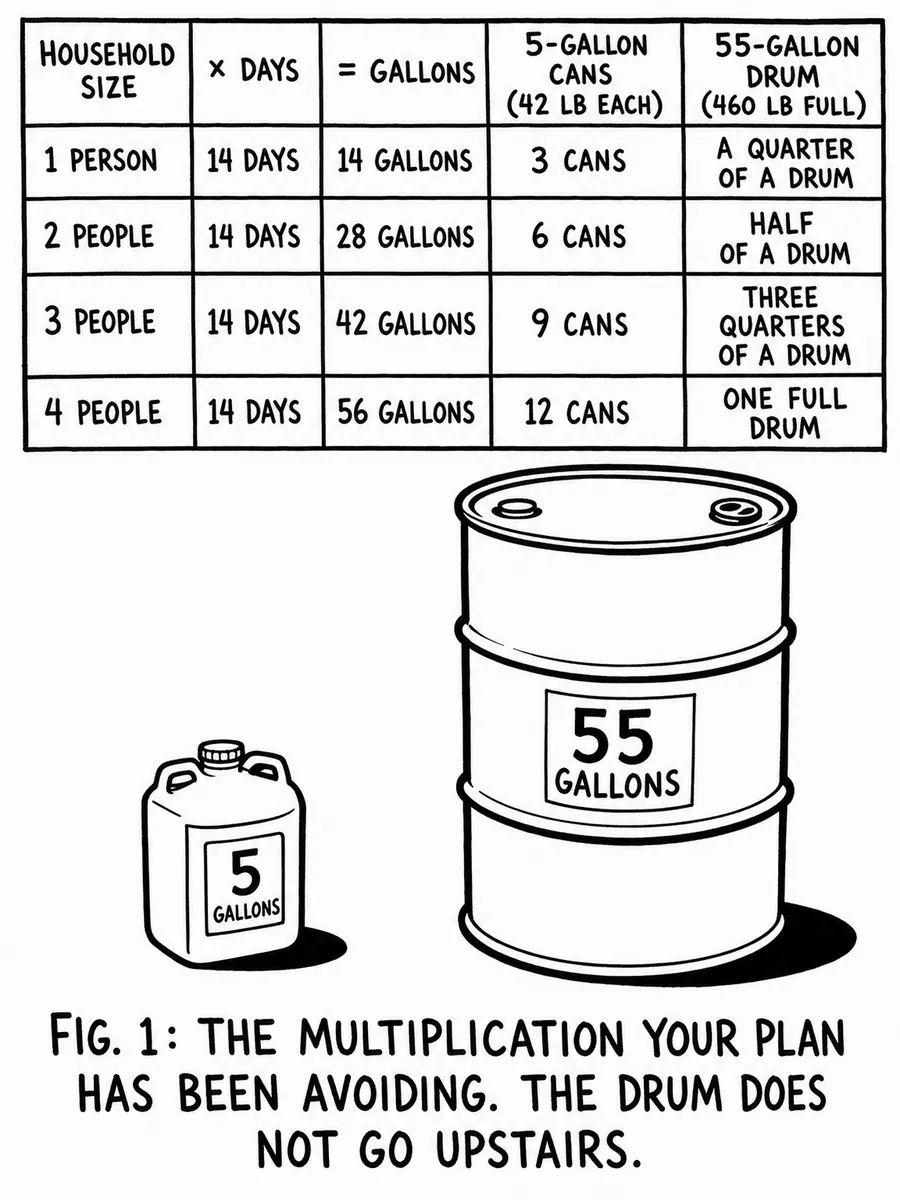
One gallon per person per day is the floor — roughly half drinking, half sanitation — and two weeks is the target. That is 14 gallons a head. Water weighs 8.34 pounds per gallon, so storage is a placement problem, not a shopping problem: two people's fortnight is 28 gallons and about 234 pounds.
From Water for City People by Dr. Buck Savage†. 208 pages · 22 illustrations.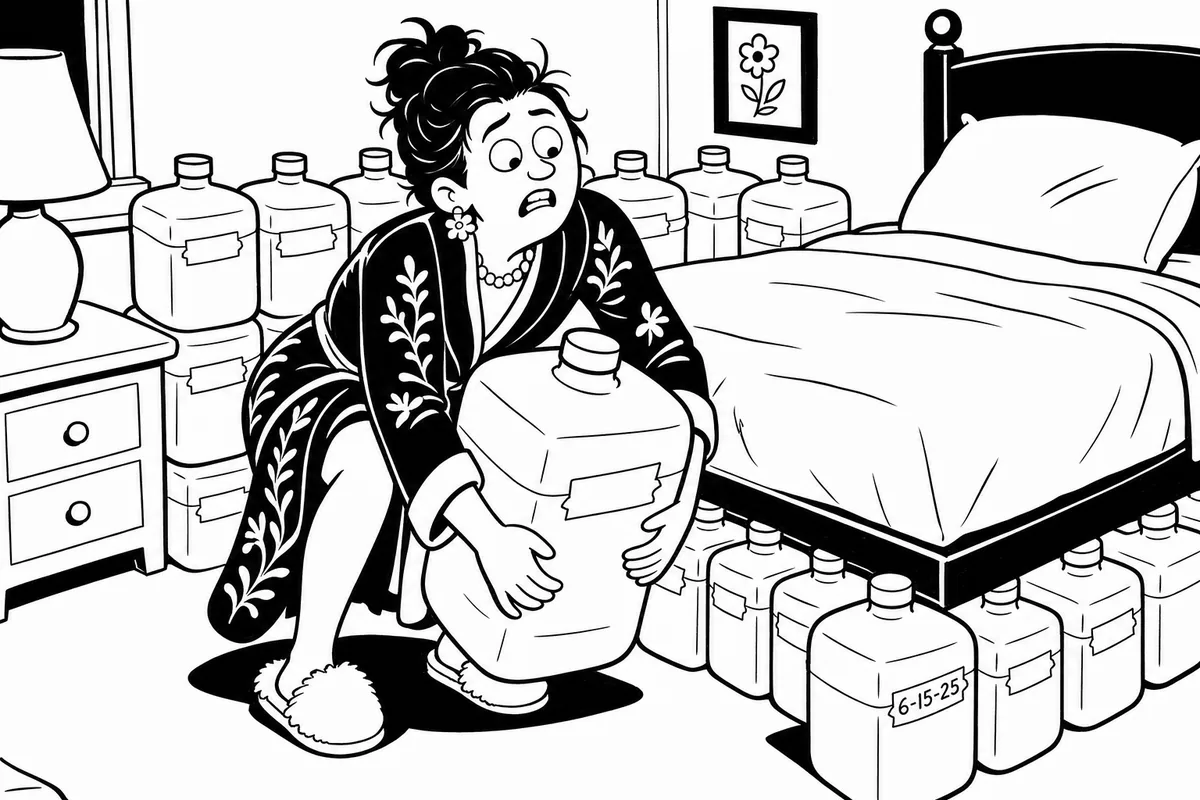

Turn on your tap. Go on, it’s fine.
Buying it for somebody else? Find their field guide.
5 things this book knows
Quoted from Water for City People exactly as printed. Every figure is the book’s own.
- Family of four: 56 gallons, plus the dog’s 7, call it 63.
- Run it: one person’s two weeks — 14 gallons — is about 117 pounds.
- Two people, 28 gallons, roughly 230 pounds: a defensive lineman lying down in your closet.
- A 5-gallon container weighs about 42 pounds filled.
- You can absolutely buy your way to 28 gallons.
The reference cards, free
Straight out of this volume’s own appendix, which opens by telling the reader to photocopy it freely and laminate it shamelessly.
THE STORAGE CALCULATOR
The rule: 1 gallon per person per day is the FLOOR. Two weeks is the target. Water weighs 8.34 lbs per gallon — plan placement, not just purchase.
| Household | 3 days (bare min.) | 1 week | 2 weeks (target) | 2-week weight |
|---|---|---|---|---|
| 1 person | 3 gal | 7 gal | 14 gal | ~117 lbs |
| 2 people | 6 gal | 14 gal | 28 gal | ~234 lbs |
| 3 people | 9 gal | 21 gal | 42 gal | ~350 lbs |
| 4 people | 12 gal | 28 gal | 56 gal | ~467 lbs |
| 5 people | 15 gal | 35 gal | 70 gal | ~584 lbs |
| Dog | — | — | ~1 oz per lb of dog per day | (70-lb dog ≈ ½ gal/day) |
| Cat | — | — | ~1 cup/day planning figure | — |
Raise the floor for: heat, hard physical work, pregnancy, nursing, illness, infants (formula = its own line item, bottled preferred), and anyone on medications where dehydration is dangerous (ask the pharmacist NOW).
YOUR NUMBER: people × 14 gal + pets gal = gallons. Write it. Post it.
Container quick-reference:
| Container | Capacity | Full weight | Notes |
|---|---|---|---|
| Store-bought flat/gallons | varies | ~8.5 lbs/gal | Easiest start; respect printed date; cool + dark |
| 2-liter PET soda bottle (cleaned/sanitized) | 0.53 gal | ~4.5 lbs | Free supplement; wash + sanitize first |
| Water brick | 3.5 gal | ~29 lbs | Stackable; under-bed/closet |
| Jerry can | 5–7 gal | 42–58 lbs | The workhorse; one hand-truck moves a fortnight |
| 55-gal drum | 55 gal | ~460 lbs | Ground floor/slab only, on pallet, pump required |
| Bathtub liner | ~60–100 gal | n/a (in tub) | Deploy at FIRST sign of trouble, while pressure lasts |
Rules that keep it drinkable: food-grade containers ONLY (never former chemical/milk jugs) • sanitize before filling (1 tsp plain unscented bleach in 1 qt water, swish all surfaces, drain, air dry) • fill from cold tap • date with masking tape • rotate self-filled every 6 months • store cool, dark, off bare concrete, away from all chemicals and sun.
PURIFICATION QUICK CARDS
(These four cards are the payload of the entire book. They are written without jokes on purpose. Copy them at full size; tape where the mugs live.)
⬛ CARD 1 — BOIL (most reliable vs. all microbes)
-
Cloudy water: settle, then pour through clean cloth/coffee filter.
-
Bring to a FULL ROLLING BOIL (whole surface churning, doesn’t pause when stirred).
-
Hold the rolling boil 1 FULL TIMED MINUTE.
-
Above ~6,500 ft (2,000 m) elevation: 3 minutes.
-
Cool covered. Store covered in a sanitized container. Label with time/date.
-
Flat taste: pour between two clean containers several times.
Boiling does NOT remove chemicals, fuel, or salt. NEVER boil with charcoal, camp stoves, gas grills, or any combustion device indoors — carbon monoxide kills. Generators outdoors only, 20+ ft from openings. Own a battery CO alarm.
⬛ CARD 2 — BLEACH (lightest, cheapest, scales to neighbors)
Use plain UNSCENTED household bleach, 5–9% sodium hypochlorite (label must say so). No scented, splashless, color-safe, or added-cleaner products. Bottle under 1 year old.
| Water | Dose per 1 GALLON | Dose per 1 QUART |
|---|---|---|
| Clear | 8 drops (~1/8 tsp) | 2 drops |
| Cloudy/colored/very cold (settle & cloth-filter first) | 16 drops (~1/4 tsp) | 4 drops |
-
Stir. Wait 30 MINUTES.
-
Water should have a slight chlorine smell. If not: repeat the same dose, wait 15 more minutes. Still no smell = discard; use another source/method.
-
5-gallon batch, clear water: 40 drops (~1/2 tsp).
Does NOT reliably kill Cryptosporidium (boil or use absolute ≤1 micron filter for that). Does NOT fix chemical contamination. Never mix bleach with ammonia or any cleaner.
⬛ CARD 3 — IODINE & TABLETS
Iodine 2% tincture: 5 drops per quart CLEAR water; 10 drops per quart cloudy. Wait 30+ minutes (longer if very cold, or warm the water first). DO NOT USE iodine for: pregnancy, thyroid disease, iodine/shellfish-iodine sensitivity, or continuous use beyond a few weeks. Does not kill Cryptosporidium.
Purification tablets: follow the label EXACTLY — tablet count, wait time, expiration. Chlorine dioxide tablets are the one chemical option rated for Cryptosporidium — only at the full labeled contact time (typically 4 hours).
⬛ CARD 4 — FILTER / UV
Filters are holes with numbers: - Protozoa (Giardia, Cryptosporidium): removed by absolute ≤1 micron (NSF 53/58 “cyst reduction”). - Bacteria: removed by 0.1–0.2 micron class (standard hollow-fiber). - Viruses: NOT removed by almost any portable filter. City flood/surface water = assume sewage = filter alone is NOT enough. Filter, THEN add bleach dose (Card 2), or boil. Or buy a purifier explicitly rated for viruses (99.99%+ claim in writing). - Pre-filter cloudy water through cloth. Backflush per manual. A hollow-fiber filter frozen while wet is ruined and looks fine — replace it. Pitcher/fridge carbon filters are taste devices, never purification.
SODIS (solar): clear PET bottle ≤2 L, label off, unscratched; water clear enough to read through; lie flat in full direct sun 6 hours (2 consecutive days if more than half-cloudy). Microbes only; no chemical help. UV pen: clear water only, full manual cycle, spare batteries or no pen.
⬛ THE FOUR METHODS AT A GLANCE
| Method | Kills bacteria | Kills viruses | Kills Crypto | Removes chemicals/salt | Cost/limits |
|---|---|---|---|---|---|
| Boil | ✔ | ✔ | ✔ | ✘ | Fuel; indoor-combustion rules absolute |
| Filter (≤1 μm abs.) | ✔ (0.1–0.2 μm class) | ✘ | ✔ | ✘ (carbon: taste/some organics) | Cartridge life; dies if frozen wet |
| Chemical (bleach/iodine) | ✔ | ✔ | ✘ | ✘ | 30-min wait; bleach ages out ~1 yr |
| Distill | ✔ | ✔ | ✔ | ✔ (not all volatiles) | Very slow, fuel-hungry |
| UV / SODIS | ✔ | ✔ | ✔ | ✘ | Clear water + sun/batteries only |
Doctrine: stack methods. City sequence: settle → filter → bleach. No fuel: settle → SODIS. Salt/metals: distill. Unknown chemical contamination: stored water only.
⬛ CARD 5 — WATER HEATER DRAIN (30–50 gallons behind the coats)
-
Heat OFF first: electric = breaker off; gas = control to OFF/PILOT. (An electric element exposed in a part-drained tank burns out and can start a fire.)
-
Close the cold-water inlet valve (top of tank). Do this at the START of any advisory even if not draining — it seals clean pre-event water inside.
-
Cool or be careful: contents are 120–140°F. Scald-safe containers, no children in the room.
-
Open a hot tap elsewhere in the home to break the vacuum.
-
Drain from the bottom valve (garden-hose thread; use a drinking-water-safe hose or fill directly). Open gently.
-
First quarts run rusty/cloudy = sediment. Run to a bucket (use for flushing) until clear; settle/cloth-filter what you keep.
-
Treat the water (Card 1 or 2) if mains pressure was lost or an advisory is active — unless the inlet was closed before the event.
-
Afterward: refill COMPLETELY (hot tap runs full, no sputter) before restoring the breaker or relighting per the manufacturer’s plate. Never energize an empty electric tank.
⬛ CARD 6 — STORED WATER: TRUST OR TREAT?
| You observe | Verdict |
|---|---|
| Sealed commercial bottle, in date, stored cool/dark | Drink |
| Self-filled, dated ≤6 months, looks/smells clean | Drink (aerate if flat) |
| Self-filled, over-date but sealed, clean look/smell | Treat (Card 1 or 2), then drink — or demote to washing |
| Any cloudiness, odor, floaters, slime, bulging container | Do not drink. Treat AND demote to sanitation, or discard |
| Unknown history / unlabeled container | Assume worst tier. Treat or discard |
| Container ever held chemicals/fuel | Discard container. Not water storage. No exceptions |
What each chapter comes down to
One line per chapter, in order — the book’s own summary of itself. The argument, the worked examples and the reasoning are in the volume.
- The Math You’re AvoidingOne gallon per person per day is the floor, two weeks is the target, and water weighs 8.34 pounds per gallon — so a real supply is 14 gallons a head, planned by placement, bought for pennies, and stored before the day the whole city does its multiplication at once.
- Storage Without Committing CrimesWater storage fails at the container, so use only food-grade vessels — store-bought bottles and 5-gallon cans you can actually lift — sanitized, filled from the tap, dated, kept cool and dark and away from chemicals, and rotated every six months. The tap fills them for pennies; the only expensive part is doing it after you need it.
- Boiling: The Old GodA full rolling boil held for 1 timed minute — 3 minutes above 6,500 feet — kills every microbe class that makes emergency water dangerous, which makes boiling the most reliable purification there is; its only real costs are fuel and the absolute, non-negotiable rule that combustion stays outdoors.
- Filters: The Membrane PriesthoodA filter is a hole with a number — 1 micron absolute takes the protozoa, 0.1–0.2 micron takes the bacteria, and almost nothing portable takes the viruses — so in a city, where bad water means sewage, a filter alone is half an answer: stack it with chemical or boil, or buy the purifier class that says “virus” in writing. And a filter that froze wet is dead and looks perfect.
- Chemistry: Eight Drops of CivilizationA three-dollar dropper bottle of plain unscented bleach — 8 drops per gallon clear, 16 cloudy, stir, wait 30 minutes, smell chlorine or repeat once — is the lightest, cheapest, most scalable purification there is, kills the viruses your filter can’t, and fails only at Cryptosporidium and chemical contamination — gaps you cover with the boil and the filter, which is why the methods are a team and not a debate.
- Steam and Sun: The Last Two DoorsDistillation is the only kitchen-scale method that removes salt, metals, and dissolved contamination — slow, fuel-hungry, and unbeatable in its lane (but no license to drink fuel-tainted water) — and UV needs nothing but clarity: a clear PET bottle, lying flat, in 6 hours of full sun (2 days if half-cloudy) disinfects for free. Ranked last, needed rarely, irreplaceable when their day comes — and the real skill is stacking all four methods to fit the day you actually get.
- The Water Hiding in Your HomeYour home already stores its own emergency supply — 30 to 50 clean gallons in the water heater (breaker off FIRST, inlet closed, hot tap open, drain low, expect sediment), one to three more in every cleaner-free toilet TANK, gallons in the pipes between your highest faucet and lowest tap — call it fifty gallons of margin behind the winter coats, findable in ten minutes, if you meet your utility closet before the emergency does.
- The City’s Hidden ReservoirsThe city stores water in the sky and on the roofs — a rooftop tank buys its building a day and booster-pump buildings get minutes, so ask your super the three questions this week; urban open water is sewage-adjacent flush-tier until fully stacked-and-treated; and one inch of rain on 1,000 square feet is 620 gallons, legal almost everywhere, regulated somewhere, and non-potable until treated — check your state before you buy the barrel.
- The Advisory ProtocolAn advisory is sequence, not crisis — read the actual tier, fill every vessel while pressure lasts, seal the heater and timestamp the ice, then run the numbers you now own (1 gal/person/day; rolling boil 1 minute, 3 at altitude; 8 drops per clear gallon, 16 cloudy, wait 30) until the lift — then flush the taps, dump the ice, change the cartridges, and debrief, because the advisory you just ran is the rehearsal for the one that counts.
- The Winter the Well Went QuietThe well was never mine — it was the grid’s, and the water that carried us was love on a rotation schedule. Store water for the people in your walls before they know to be afraid; the protocol you practice in calm weather is the sober you, showing up with counted drops on the night your hands shake.
Common questions
How long should I boil water to make it safe?
Bring it to a full rolling boil — the whole surface churning, not pausing when stirred — and hold it there for one full timed minute. Above about 6,500 feet, three minutes. Boiling does not remove chemicals, fuel or salt.
How much bleach purifies a gallon of water?
Eight drops (about 1/8 teaspoon) of plain unscented household bleach at 5–9% sodium hypochlorite per gallon of clear water. Sixteen drops if it is cloudy, cold or coloured, and filter it through cloth first. Stir, wait 30 minutes. It does not reliably kill Cryptosporidium.
Will a water filter make river water safe to drink?
Not on its own. Almost no portable filter removes viruses. City flood or surface water should be assumed to contain sewage, so filter and then add a bleach dose, or boil — unless the unit is explicitly rated for viruses in writing.
What this book is not
It is a field guide, not a medical, legal or structural authority. Where a mistake maims or kills, the book stops joking and says so on the page; this site does the same. Nothing here replaces emergency services, a physician, a licensed tradesperson, or the law where you live.
This edition
| Series | For City People, volume 2 of 10 |
| Pages | 208, 6 × 9 in |
| Illustrations | 22, drawn for this book |
| Words | 32,882 |
| Paperback | 979-8-90623-257-1 |
This page is a reference, not an authority. It is field-guide material, not medical, legal, electrical or structural advice, and nothing on it replaces emergency services, a physician, a licensed tradesperson, or the law where you live.
No plant is edible on the say-so of a web page. In a real emergency the first instruction is to call for help. Local code outranks any page here.
Dr. Buck Savage is a fictional narrator and is not a doctor. The reference material is real and is drawn from the published books; the man is not.
Department of tactful suggestions / volume 02
Someone came to mind.
Send them a field guide. Let the cover do the explaining.