Volume 01 of 10 · For City People
Foraging
Yes, That’s a Weed. No, Don’t Eat It. Okay, Eat THAT One.
Is it safe to forage for food in a city?
Only with positive identification and a cleared site. Run the Rule of Three Confirmations on every plant, every time: the whole plant matches a regional guide, the environment fits the species, and you have affirmatively checked the one feature its dangerous lookalike lacks. Then clear the ground — what was here before, what do they spray, what is uphill.
From Foraging for City People by Dr. Buck Savage†. 186 pages · 14 illustrations.
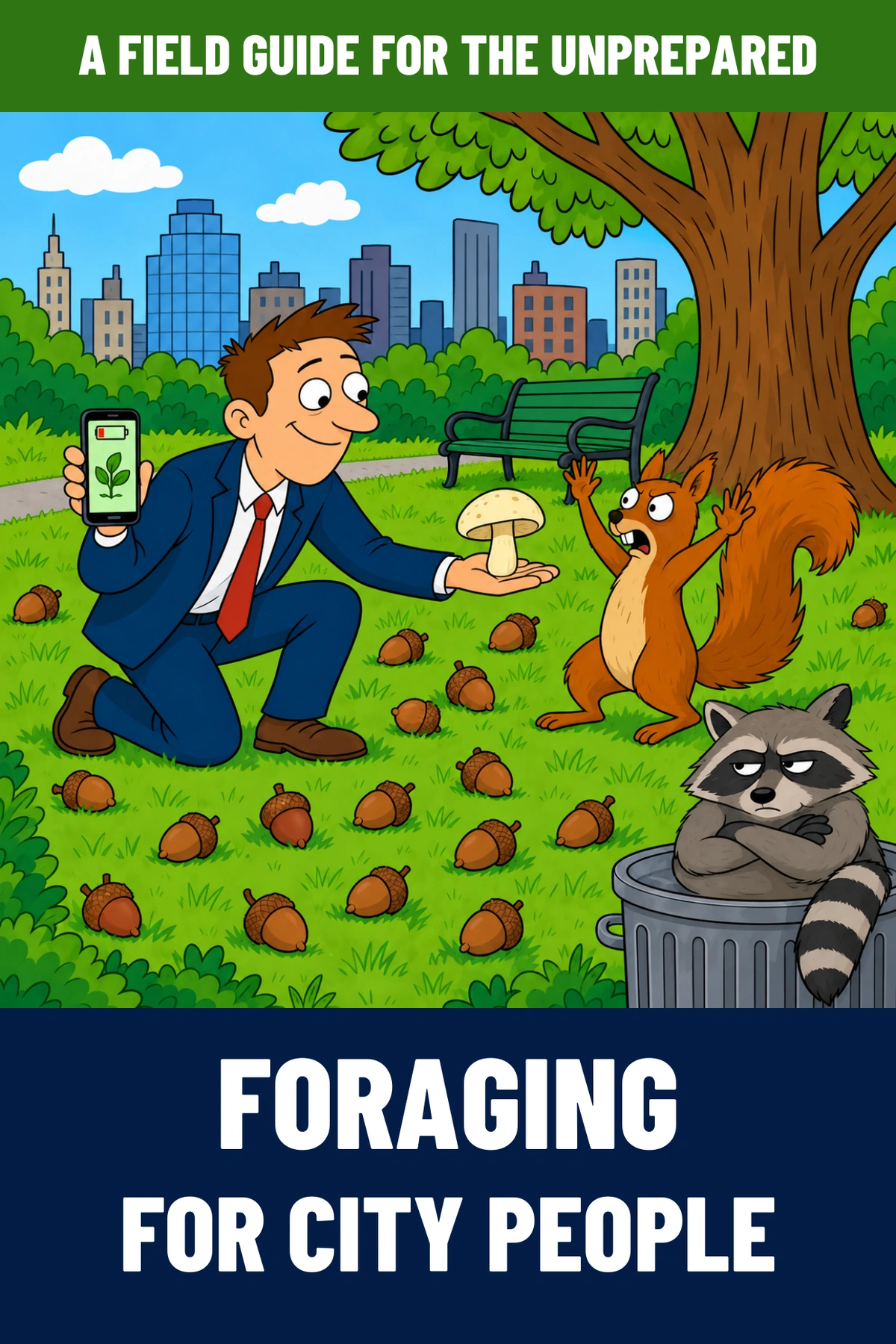
There is a grocery store outside your building. It has no app, no line, and no hours, and everything in it is free. About a third of it wants you dead.
Buying it for somebody else? Find their field guide.
3 things this book knows
Quoted from Foraging for City People exactly as printed. Every figure is the book’s own.
- New plants debut alone, in small portions, 24 hours apart.
- Forked tendrils present + 1–4 round seeds per fruit = grape.
- Keep one raw specimen from every wild mushroom meal in the fridge, in paper, for 48 hours.
The reference cards, free
Straight out of this volume’s own appendix, which opens by telling the reader to photocopy it freely and laminate it shamelessly.
THE RULE OF THREE CONFIRMATIONS (the whole religion, wallet-sized)
-
SHAPE — every part matches a trusted regional guide: leaf, stem, flower, root, growth habit. “Looks like” is not “matches.”
-
ENVIRONMENT — right region, habitat, season, and neighbors for the species.
-
DIFFERENTIATOR — you know the deadly/bad twin, and you have affirmatively checked the one feature the twin lacks.
Corollaries: new plants debut alone · first portion stupid small, wait 24h · keep a sample/photos of everything you eat · beginners stay out of the carrot family (Apiaceae), entirely, indefinitely.
Site clearance (city addendum): What was this land before? · What do they spray? · What’s uphill? — No good answers, no harvest. Washing removes what fell ON a plant, never what grew INTO it.
THE FIFTEEN — ID QUICK-REFERENCE CARDS
(One card per species. ID = confirm shape; ✓ = the differentiator check; ✗ = the twin and its tell.)
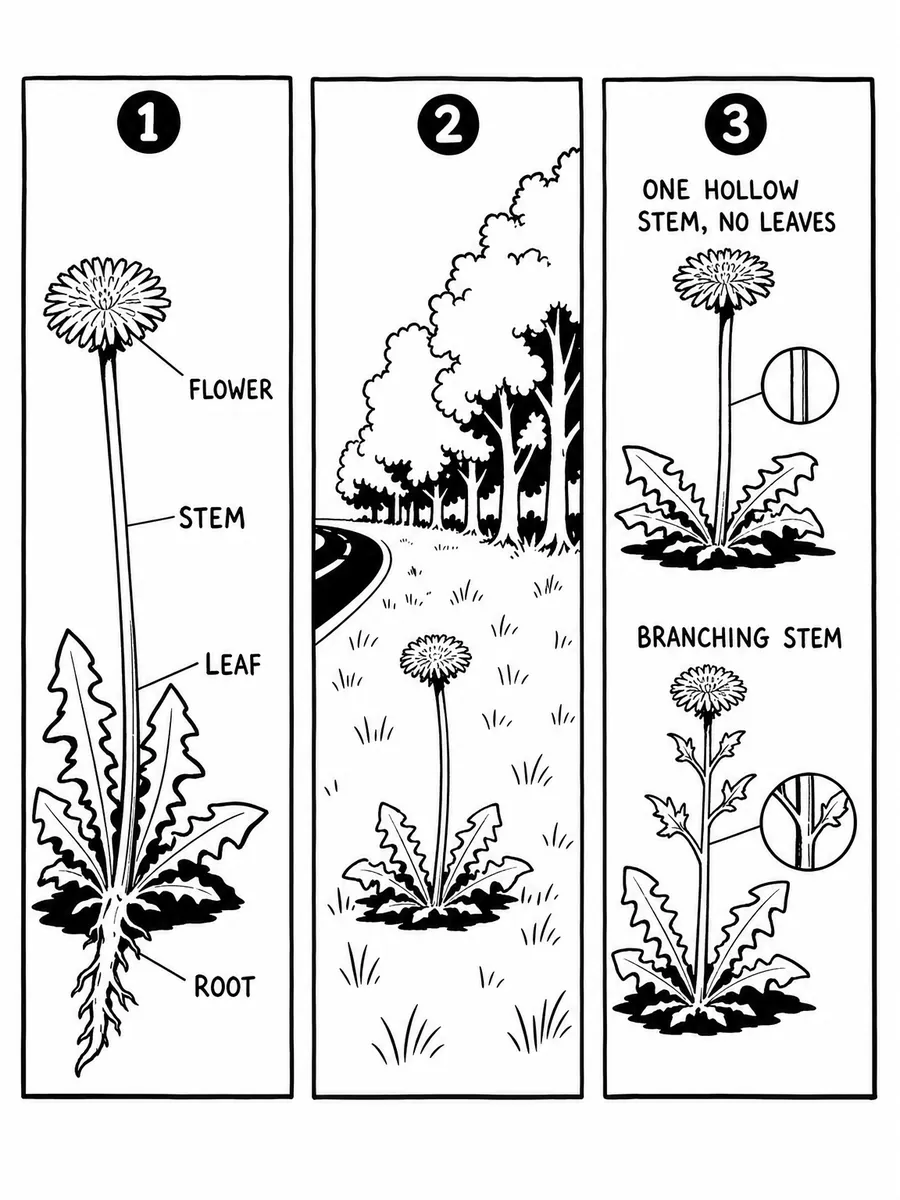
1. DANDELION — rosette of backward-toothed leaves; single hollow leafless stem per flower; milky sap. ✓ one flower / one unbranched hollow stem. ✗ false dandelions (catsear, sow thistle): branching or solid stems — all edible anyway; the training-wheels plant. Eat: leaves, flowers, roasted root. Season: spring–fall.
2. BROADLEAF / NARROWLEAF PLANTAIN — ground rosette; oval or lance leaves; parallel veins that pull like celery strings; bottlebrush seed spike. ✓ parallel veins + basal rosette + spike (no toxic plant does all three). Eat: young leaves, seeds. Bonus: crushed-leaf poultice for stings. Season: spring–fall.
3. CHICKWEED — sprawling mat; opposite oval leaves; five split petals (looks like ten); single line of hairs switching sides down the stem; stretchy inner core; clean sap. ✓ one-sided hair line + NO milky sap. ✗ spurge: milky irritant sap — drop it. Eat: tender tops, raw. Season: cool months.
4. PURSLANE — prostrate succulent mat; fat smooth paddle leaves; thick reddish stems; clean wet snap. ✓ succulent + smooth + no sap. ✗ spurge again: thin wiry hairy stems + milky sap. Eat: all above ground, raw/cooked. Highest omega-3 of common greens. Season: high summer.
5. WOOD SORREL — three heart-shaped folded leaflets; five-petal yellow star flowers; lemon-sour taste. ✓ hearts, not ovals. ✗ clover (harmless): oval leaflets, pom-pom flower. Eat: leaves/flowers/pods as accent — oxalic acid, moderation; kidney-stone-prone consult a doctor. Season: all warm months.
6. ACORNS (WHITE OAK GROUP) — rounded leaf lobes, no bristle tips; nuts mature in one year. ✓ float test (sinkers only), then LEACH until a nibble is clean — taste is the only timer. Cold leach = flour; hot leach = porridge/roast. ✗ red oak group (bristle-tipped lobes): edible, needs longer leaching. Store flour in freezer. Season: fall.
7. MULBERRY — tree-hung slim blackberry-lookalike fruit; glossy toothed leaves in mitten/oval/lobed mix on one tree; purple sidewalk stains are the beacon. ✓ aggregate fruit ON A TREE. ✗ none serious in temperate cities; unripe fruit + leaves = GI upset — dead-ripe only. Season: early summer. Tarp + shake.
8. CRABAPPLE — small true apples on ornamental trees; five-point blossom-end star. ✓ it’s an apple at any size. ✗ none (all true apples edible) — but core before bulk processing (seed cyanogenics); jelly champion via natural pectin. Season: late summer–fall.
9. LINDEN (BASSWOOD) — street tree; heart-shaped leaves; cream flower clusters hung from a strap-like bract; famous perfume in June. ✓ the strap bract — nothing else on your street has it. Eat: young spring leaves (salad), dried flowers (tea). Season: leaves spring, flowers early summer.
10. PINE (TRUE PINES ONLY) — long needles in bundled sleeves of 2/3/5; woody cones. ✓ bundled needles + true cones = pine. ✗ YEW: short flat soft SINGLE needles, red berry-cup open at one end — DEADLY, planted everywhere, zero tolerance. Pregnant: skip pine tea entirely. Use: needle tea (hot, not boiled, 10 min). Season: all year.
11. BLACK WALNUT — big ferny compound leaves; green tennis-ball drops; husk stains everything forever. ✓ nothing else looks or smells like it (citrus-spice husk). Gloves; cure in shell 2 weeks; freeze shelled meats. Season: fall.
12. BRAMBLES (BLACKBERRY / RASPBERRY / WINEBERRY) — thorned arching canes; aggregate fruit (fist of tiny balloons). ✓ compound drupelets on a cane = the safest fruit rule in the temperate world; raspberry picks hollow; wineberry canes fuzzy red (invasive — feast). ✗ none deadly; worst case sour. Season: high summer. Site rules still apply.
13. WILD GRAPE — climbing vine, lobed heart leaves, forked tendrils; uniform dark fruit clusters. ✓ EVERY cluster: tendrils present + crush one fruit = 1–4 round pear-ish seeds. ✗ MOONSEED: NO tendrils, ONE flat crescent seed — genuinely toxic. Also ✗ Virginia creeper (5 leaflets) and porcelain berry (multicolor clusters). Season: fall.
14. ELDERBERRY — woody shrub thickets; paired compound leaves; flat cream flower plates → drooping dark berry umbrellas. ✓ woody + pithy stems + paired leaves. Berries COOKED and RIPE only; stems/leaves/green berries never. ✗ pokeweed (fleshy magenta stalk — toxic berries) · water hemlock (lace flowers, purple-blotched hollow stems — deadly; beginners leave all lace alone). Season: flowers early summer, berries late.
15. SERVICEBERRY (JUNEBERRY) — planted street/park tree; smooth gray bark; oval fine-toothed leaves; June fruit like red-purple blueberries wearing a five-point crown. ✓ the crown (pome family badge) + planted-row habit. ✗ none serious with crown confirmed. Season: June. Beat the birds.
THE NO LIST (know these like stop signs — Ch. 6)
-
DEATH CAP (Amanita phalloides) — pale green-yellow cap, white gills, skirt ring, volva cup at base (dig, don’t cut). Near oaks, incl. planted city trees.
-
DESTROYING ANGEL (white Amanitas) — all-white elegance + volva; button stage mimics store mushrooms → the reason every puffball gets sliced.
-
GALERINA — small rusty-brown, on rotting wood, ring on stem; carries death-cap toxins → ALL “little brown mushrooms” are permanently off-limits.
-
FALSE MOREL (Gyromitra) — brain-wrinkled (not honeycombed), chambered/cottony inside (not hollow), skirt-hung (not fused).
AMATOXIN TIMELINE (why “I feel fine” means nothing): 6–12+ h silent → violent GI storm → false recovery, 1–2 days — the phase that kills via reassurance → liver failure. Cooking does NOT destroy amatoxin. Half a cap can kill. ANY symptoms after ANY wild mushroom meal → ER immediately, say “possible amatoxin,” bring a specimen in paper.
What each chapter comes down to
One line per chapter, in order — the book’s own summary of itself. The argument, the worked examples and the reasoning are in the volume.
- The Rule of Three ConfirmationsThree confirmations, every plant, every time — the full shape matches, the environment fits, and you have affirmatively ruled out the deadly twin. Anything less isn’t identification. It’s a bet, and the house is a hedge.
- Your City Is a Salad With Trust IssuesIn the city, identification is only half the Rule — location is the other half. Three questions for every site: what was this land before, what do they spray, what’s uphill. No good answers, no harvest. And washing removes what fell on a plant, never what grew into it.
- The Unkillable FiveFive plants — dandelion, plantain, chickweed, purslane, wood sorrel — chosen because they’re everywhere and their worst-case mistakes are survivable. Run the full Rule on all five until it’s muscle memory. Milky sap is evidence, not a verdict: it confirms a dandelion and condemns a spurge. Reps make the forager.
- Trees: The Tall FoodThe canopy is the only urban forage with real calories — one good oak out-feeds an acre of salad. Acorns are food after leaching, and taste is the only test that counts. Follow the mulberry stains, respect the walnut, and never brew “pine” tea from anything you haven’t three-confirmed — the yew is planted everywhere and forgives nothing.
- Fruit of the Fence LineStructure sets the stakes. Aggregate cane-berries can’t be faked — pick them with a clean site and a light heart. Grapes can be faked by a killer — tendrils and crescent-seed check, every cluster. Elderberry cooked and ripe only. And half the “landscaping” on your block is an orchard nobody labeled.
- Mushrooms, Part One: Don’tYou are not learning mushrooms to eat them. You are learning four killers by sight so you can afford the question. The No List is the license; Chapter Seven is the vehicle; neither works alone.
- Mushrooms, Part Two: Okay, These FourFour species, four destructive checks: morels hollow and fused; chanterelles wear ridges, jacks wear blades; chicken’s ID includes the tree; puffballs sliced white-all-through, every time — that slice is what catches the Amanita button doing its impression. First specimen of each past a human expert. The knife confirms before it harvests.
- The Law of the Land (You’re Standing on Someone’s)There is no Law of Foraging — only a quilt of weird little rules, all findable in thirty minutes: city code, state parks, national forest (forests yes-ish, National Parks never). On private land, the door knock outperforms every statute. And above it all: never the first, never the last, never more than a third.
- Keeping It: Preservation for People With One ShelfThe harvest arrives in floods on the plant’s schedule; preservation is how you answer. Dry what’s leafy, tray-freeze what’s precious, pickle and jelly inside the acid line — and leave everything low-acid to Book Three’s pressure canner. One shelf and seventy-two honest hours turn a glut into a pantry.
- The Rest of the Mushroom StoryHow you feel is not information — check, or don’t eat. And competence was never a scoreboard. It’s how you love the people who worry about you.
Common questions
What is the Rule of Three Confirmations?
Shape, environment, and differentiator. The whole plant matches a trusted regional guide — leaf, stem, flower, root, growth habit. The region, habitat, season and neighbouring plants fit the species. And you know the dangerous twin and have checked the one feature it lacks. Anything less is a bet.
Which wild plants are safest for a beginner?
Dandelion, plantain, chickweed, purslane and wood sorrel — chosen because they grow almost everywhere and their worst-case mistakes are survivable. Beginners should stay out of the carrot family (Apiaceae) entirely and indefinitely.
Is it safe to eat plants growing beside a road?
Washing removes what fell on a plant, never what grew into it. Ask three questions before you pick anything: what was this land before, what do they spray here, and what is uphill of it. No good answers, no harvest.
What this book is not
It is a field guide, not a medical, legal or structural authority. Where a mistake maims or kills, the book stops joking and says so on the page; this site does the same. Nothing here replaces emergency services, a physician, a licensed tradesperson, or the law where you live.
This edition
| Series | For City People, volume 1 of 10 |
| Pages | 186, 6 × 9 in |
| Illustrations | 14, drawn for this book |
| Words | 32,416 |
| Paperback | 979-8-90623-255-7 |
This page is a reference, not an authority. It is field-guide material, not medical, legal, electrical or structural advice, and nothing on it replaces emergency services, a physician, a licensed tradesperson, or the law where you live.
No plant is edible on the say-so of a web page. In a real emergency the first instruction is to call for help. Local code outranks any page here.
Dr. Buck Savage is a fictional narrator and is not a doctor. The reference material is real and is drawn from the published books; the man is not.
Department of tactful suggestions / volume 01
Someone came to mind.
Send them a field guide. Let the cover do the explaining.